This is the multi-page printable view of this section. Click here to print.
Arts
- 1: Pharmaceuticals
- 1.1: Introduction
- 1.1.1: Artificial Intelligence
- 1.1.2: Introduction to Pharmaceutical Regulations & Guidelines
- 1.1.2.1: International Council for Harmonisation
- 1.1.2.1.1: Core Standards
- 1.1.2.1.1.1: ICH Q1 Stability
- 1.1.2.1.1.2: ICH Q2 Stability Testing
- 1.1.2.1.1.3: ICH Q3 Impurities
- 1.1.2.1.1.4: ICH Q4 Pharmacopoeial Harmonisation
- 1.1.2.1.1.5: ICH Q5 Quality of Biotechnological Products
- 1.1.2.1.1.6: ICH Q6 Specifications
- 1.1.2.1.1.7: ICH Q7 Good Manufacturing Practice
- 1.1.2.1.1.8: ICH Q13 Continuous Manufacturing
- 1.1.2.1.1.9: ICH Q14 Analytical Procedure Development
- 1.1.2.1.2: Quality by Design
- 1.1.2.1.2.1: QbD for Biopharm
- 1.1.2.1.2.1.1: A-Mab Case Study
- 1.1.2.1.2.2: ICH Q8 Pharmaceutical Development
- 1.1.2.1.2.3: ICH Q9 Quality Risk Management
- 1.1.2.1.2.4: ICH Q10 Pharmaceutical Quality System
- 1.1.2.1.2.5: ICH Q11 Development and Manufacturing of Drug Substances
- 1.1.2.1.2.6: ICH Q12 Lifecycle Management
- 1.1.2.1.3: Transcelerate
- 1.1.2.1.3.1: Interlocking SIPOCs
- 1.1.2.1.3.2: Knowledge Management
- 1.1.2.1.3.3: Risk Framework
- 1.1.2.2: Why You Must Keep Data Human-Readable — Even Years Later
- 1.1.3: Control Strategies
- 1.1.4: Drug Development Process
- 1.2: Scientific Method in Digital Age
- 1.2.1: Critical Question
- 1.2.2: Design
- 1.2.3: Data Collection
- 1.2.4: Aggregation
- 1.2.5: Analysis
- 1.2.6: Reporting
- 2: Knowledge Management: The Strategic Foundation of Research
- 2.1: From Trenches to Transformation: How Design Study Methodology Can Accelerate Knowledge Evolution in 2025
- 2.2: Ontological Semantics
- 3: Industrial Revolution 4.0: The Dawn of Intelligent Manufacturing
- 3.1: Understanding Big Data: The 5 Vs That Define Modern Analytics
- 3.2: Cyber-Physical Systems: The Digital Bridge to Industry 4.0
- 3.3: Internet of Things: Connecting the World One Device at a Time
- 3.4: Interoperability: The Foundation of Connected Innovation
- 3.5: Smart Factories: Where Digital Dreams Meet Physical Reality
1 - Pharmaceuticals
The development and delivery of medicinal products is both an art and a science. Beyond the rigorous research and clinical trials, the process involves creativity, collaboration, and a deep understanding of human needs. The pharmaceutical arts encompass:
- Discovery & Innovation: Identifying new compounds and therapeutic approaches requires not only scientific expertise but also imagination and persistence.
- Formulation & Design: Transforming active ingredients into effective, safe, and accessible medicines involves chemistry, engineering, and the art of problem-solving.
- Manufacturing & Quality: Producing medicines at scale demands precision, consistency, and a commitment to the highest standards of quality and safety.
- Distribution & Access: Ensuring that life-saving treatments reach those in need involves logistics, policy, and a dedication to equity and global health.
- Communication & Trust: Building public confidence in new therapies relies on clear communication, transparency, and ethical responsibility.
Pharmaceuticals are the result of diverse talents—scientists, engineers, clinicians, designers, logisticians, and communicators—working together to turn discoveries into real-world solutions that save lives. This ongoing journey blends technical mastery with the human touch, shaping the future of medicine for all.
For more on the intersection of science, art, and medicine, see APS News: The Art of Drug Development
1.1 - Introduction
The pharmaceutical industry is a dynamic and complex field dedicated to discovering, developing, and delivering medicines that improve and save lives. Success in this industry depends on the integration of rigorous scientific research, robust regulatory frameworks, and innovative technologies.
At the heart of pharmaceutical progress is a structured clinical development process, designed to ensure that new drugs are both safe and effective. This process is governed by global standards set by the International Council for Harmonisation (ICH), whose guidelines help harmonize regulatory requirements and facilitate the development and approval of medicines worldwide.
In recent years, automation and digital transformation have become essential to the industry. Automation in laboratories and manufacturing environments enhances efficiency, data integrity, and reproducibility, while digital tools enable better data management, advanced analytics, and streamlined operations across the drug development lifecycle.
This framework explores three interconnected pillars shaping the future of pharmaceuticals:
- Clinical Development Process: The pathway from discovery to approval, including preclinical research, clinical trials, and regulatory submission.
- ICH Regulations: The global standards that guide quality, safety, and efficacy in drug development.
- Automation and Digitalization: The technologies transforming research, manufacturing, and regulatory compliance.
Understanding these areas is key to appreciating the challenges and opportunities facing the pharmaceutical sector as it strives to deliver innovative therapies to patients around the world.
Cost of Pharma (ref)#
IRR depends on both efficiency and value creation#
R&D Spending:
- Increased from $139.2 billion in 2022 to $145.5 billion in 2023 (4.5% rise).
Asset Development Costs:
- Average cost to progress an asset from discovery to launch remains at $2.3 billion (steady from 2022 to 2023).
Peak Sales Forecast:
- Average forecast peak sales per pipeline asset dropped from $389 million in 2022 to $362 million in 2023.
- Continued decline from 2021 peak of $500 million, largely due to high-value COVID-19 assets.
1.1.1 - Artificial Intelligence
There has been a lot of hype around AI and pharma - how it can reduce costs and remove a lot of manual labor that for sometime was always seen as necessary human activities, that is writing. But now with large language models, AI can really start eroding away at those manual human tasks and launch us into the Industry 5.0 mentality of workers with AI assistance to do their jobs.
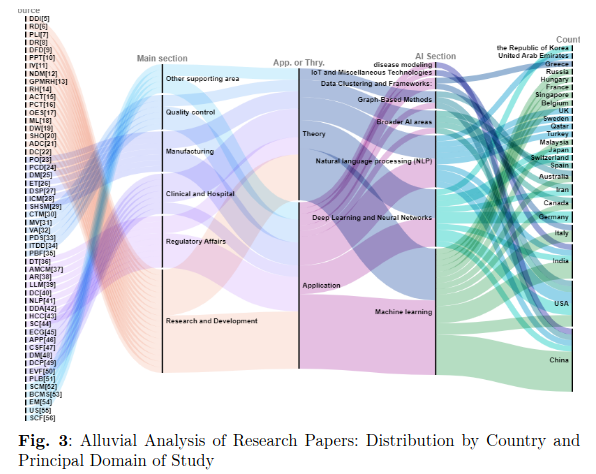
Where countries are spending their time - ref: https://arxiv.org/pdf/2401.10273
Recent Trends#
A great paper was published
Machine Learning Techniques: This category encompasses a variety of algorithms, including Support Vector Machines (SVM), Reinforcement Learning, and other traditional machine learning methods.
Deep Learning and Neural Networks: This includes models like Convolutional Neural Networks (CNN), Transfer Learning, Digital Twins (DTs), and other approaches based on neural network architectures.
Natural Language Processing (NLP): This segment covers all aspects of NLP, including Large Language Models (LLMs).
Graph-Based Approaches: Involves methods that leverage network and knowledge graphs, along with various graph-related techniques.
Data Clustering and Frameworks: Encompasses specialized frameworks such as Density-Based Spatial Clustering of Applications with Noise (DBSCAN), Federated Learning Frameworks, and other clustering or data framework technologies.
IoT and Miscellaneous Technologies: A broad category for various technologies, including the Internet of Things (IoT) and others that don’t neatly fit into the previously mentioned categories.
1.1.2 - Introduction to Pharmaceutical Regulations & Guidelines
The pharmaceutical industry operates within one of the most highly regulated environments in the world. Regulations and guidelines are essential to ensure that medicines are safe, effective, and of the highest quality—protecting patients and supporting public health. These requirements span every stage of the drug lifecycle, from discovery and development to manufacturing, distribution, and post-market surveillance.
Why Regulations Matter#
Regulatory frameworks are designed to:
- Safeguard patient safety and product efficacy
- Ensure data integrity and transparency
- Promote consistency and quality in manufacturing and clinical practices
- Enable global harmonization and efficient market access
Key Regulatory Areas#
This section introduces the major regulatory domains that shape pharmaceutical practice:
International Guidelines (ICH): The International Council for Harmonisation (ICH) brings together regulatory authorities and industry to develop harmonized guidelines on quality, safety, efficacy, and multidisciplinary topics. These standards are adopted globally and form the backbone of pharmaceutical regulation.
Explore ICH Guidelines »Electronic Records & Data Integrity (21 CFR Part 11): Digital transformation in pharma requires strict controls on electronic records and signatures. Regulations like the U.S. FDA’s 21 CFR Part 11 and the EU’s Annex 11 ensure that data is accurate, secure, and human-readable throughout its lifecycle.
Learn about 21 CFR Part 11 »Good Practice Standards (GxP): GxP encompasses Good Manufacturing Practice (GMP), Good Clinical Practice (GCP), and Good Laboratory Practice (GLP), among others. These standards govern how medicines are developed, tested, produced, and monitored.
Global and Local Regulations: In addition to ICH and FDA requirements, companies must comply with region-specific regulations (e.g., EMA in Europe, PMDA in Japan, NMPA in China) and adapt to evolving expectations around topics like data privacy, pharmacovigilance, and supply chain security.
Navigating the Landscape#
Staying compliant requires a deep understanding of both the letter and the spirit of these regulations. This section serves as a hub for exploring the foundational guidelines and regulatory expectations that underpin pharmaceutical innovation and patient safety.
Use the navigation to dive deeper into:
- ICH Guidelines
- 21 CFR Part 11 & Digital Compliance
- Other key regulatory topics and best practices
Regulatory compliance is not just a legal obligation—it is a commitment to quality, transparency, and trust in every medicine.
1.1.2.1 - International Council for Harmonisation
The International Council for Harmonisation of Technical Requirements for Pharmaceuticals for Human Use (ICH) is unique in bringing together regulatory authorities and the pharmaceutical industry to discuss scientific and technical aspects of pharmaceuticals and develop harmonised guidelines. Since its inception in 1990, ICH has evolved to address the increasingly global nature of the pharmaceutical sector, with its guidelines now adopted by a growing number of regulatory authorities worldwide. The mission of ICH is to achieve greater harmonisation to ensure that safe, effective, and high-quality medicines are developed, registered, and maintained efficiently while meeting rigorous standards. As of 2015, ICH has expanded to include 23 Members and 35 Observers. (ref)
Our Focus#
This section explores the evolving landscape of pharmaceutical harmonisation, with a focus on three key areas:
ICH Core Guidelines#
The ICH Core guidelines form the foundation for global pharmaceutical quality, safety, and efficacy standards. These guidelines are organized into several series, including:
Quality (Q) Guidelines: Covering topics such as stability, analytical validation, impurities, and pharmaceutical development.
See: ICH Quality GuidelinesSafety (S), Efficacy (E), and Multidisciplinary (M) Guidelines: Addressing nonclinical safety, clinical studies, and cross-cutting topics.
Explore the ICH Core documents for detailed breakdowns of each major guideline, including Q1–Q14 and their practical implications.
Quality by Design (QbD)#
Quality by Design (QbD) is an advanced approach promoted by ICH to ensure pharmaceutical quality through proactive design and robust process understanding. QbD principles are embedded in guidelines such as ICH Q8–Q12, focusing on:
- Systematic development and manufacturing
- Risk management and knowledge management
- Continuous improvement throughout the product lifecycle
Dive into our QbD section for resources, case studies, and biopharmaceutics applications, including real-world examples and supporting documents.
TransCelerate and Industry Collaboration#
Beyond ICH, industry consortia like TransCelerate BioPharma are driving innovation in clinical development and regulatory science. TransCelerate’s initiatives complement ICH’s harmonisation efforts by:
- Streamlining clinical trial processes
- Advancing data standards and digital solutions
- Promoting best practices for quality and compliance
Learn more about these collaborative efforts and their impact on global pharmaceutical development in our TransCelerate resources.
This section is organized to help you navigate the core ICH guidelines, understand the principles and practice of QbD, and appreciate the broader context of industry collaboration. Use the navigation to explore each
1.1.2.1.1 - Core Standards
The ICH Q1 through Q7 guidelines focus on various aspects of pharmaceutical quality and safety, including stability testing, analytical method validation, impurity control, and good manufacturing practices. Q1 emphasizes stability studies, while Q2 covers the reliability of analytical methods. Q3 addresses impurity management, and Q4 promotes harmonization of pharmacopoeial standards. Q5 focuses on biotechnological products, Q6 outlines specifications for drug quality, and Q7 details GMP for active pharmaceutical ingredients. Additionally, Q13 discusses continuous manufacturing practices, and Q14 provides guidance on analytical method development and validation, ensuring a consistent approach to product quality across the industry.
1.1.2.1.1.1 - ICH Q1 Stability
Understanding ICH Q1 Stability Guidelines#
Introduction to ICH Q1
The International Council for Harmonisation (ICH) guidelines play a crucial role in the pharmaceutical industry, ensuring the safety, efficacy, and quality of medicines. Among these guidelines, ICH Q1 focuses on stability testing, which is essential for determining the shelf life and storage conditions of drug products.
Key Objectives of ICH Q1
ICH Q1 outlines the principles for stability testing of pharmaceuticals. Its primary objectives include:
- Establishing Shelf Life: Determining the appropriate expiration dates for drug products.
- Storage Conditions: Identifying optimal storage conditions to maintain drug stability.
- Quality Assessment: Ensuring that products meet required quality standards throughout their shelf life.
Stability Testing Guidelines
The guidelines categorize stability studies into three key aspects:
- Long-term Stability Studies: These assess the product’s stability under normal storage conditions over an extended period.
- Accelerated Stability Studies: Conducted under exaggerated conditions, these studies predict the product’s shelf life in a shorter timeframe.
- Intermediate Stability Studies: These are optional but can provide additional insights for products needing further evaluation.
Regulatory Compliance
Adhering to ICH Q1 is vital for regulatory submissions. Companies must provide stability data to regulatory authorities, ensuring compliance with regional requirements and facilitating the approval process for new drug applications.
Conclusion
In summary, ICH Q1 stability guidelines are fundamental for pharmaceutical development, enabling manufacturers to ensure product quality and safety. By adhering to these guidelines, companies can better meet regulatory expectations and enhance consumer trust in their products.
1.1.2.1.1.2 - ICH Q2 Stability Testing
An Overview of ICH Q2: Guidelines for Analytical Validation#
Introduction to ICH Q2
The ICH Q2 guidelines, part of the International Council for Harmonisation (ICH) framework, focus on the validation of analytical methods used in the pharmaceutical industry. These guidelines are essential for ensuring the reliability and consistency of analytical results, which are critical for drug development and quality control.
Key Objectives of ICH Q2
The main objectives of ICH Q2 include:
- Method Reliability: Ensuring that analytical methods produce consistent and reproducible results.
- Regulatory Compliance: Providing a standardized approach that aligns with global regulatory requirements for pharmaceutical testing.
- Data Integrity: Supporting the accuracy and integrity of data generated from analytical testing.
Key Principles of Analytical Validation
ICH Q2 outlines several important criteria for validating analytical methods, including:
- Specificity: The ability of the method to measure the analyte in the presence of other components.
- Linearity: The method’s ability to produce results proportional to the concentration of the analyte.
- Accuracy: The closeness of the measured value to the true value.
- Precision: The degree of variability in the results when the method is applied repeatedly.
- Detection Limit: The lowest quantity of the analyte that can be reliably detected.
- Quantitation Limit: The lowest quantity that can be reliably quantified.
- Robustness: The method’s capacity to remain unaffected by small variations in experimental conditions.
Regulatory Importance
Compliance with ICH Q2 is critical for pharmaceutical companies seeking regulatory approval. Validated analytical methods provide the necessary data to support the safety and efficacy of drug products, ultimately aiding in successful submissions to health authorities.
Conclusion
In summary, ICH Q2 serves as a foundational guideline for the analytical validation of pharmaceutical methods. By adhering to these standards, companies can ensure the reliability of their testing processes, meet regulatory expectations, and maintain high-quality products in the market.
1.1.2.1.1.3 - ICH Q3 Impurities
An Insight into ICH Q3: Impurities in Drug Substances and Products#
Introduction to ICH Q3
ICH Q3 guidelines, developed by the International Council for Harmonisation (ICH), provide a comprehensive framework for evaluating impurities in drug substances and products. Understanding and controlling impurities is vital for ensuring the quality, safety, and efficacy of pharmaceuticals.
Key Objectives of ICH Q3
The primary objectives of ICH Q3 include:
- Impurity Characterization: Identifying and quantifying impurities in drug substances and products.
- Quality Assurance: Ensuring that impurity levels remain within acceptable limits to protect patient safety.
- Regulatory Compliance: Providing a standardized approach to impurity testing that aligns with global regulatory expectations.
Categories of Impurities
ICH Q3 classifies impurities into three main categories:
- Organic Impurities: These may arise from the synthesis process, degradation, or contamination. Understanding their origin is crucial for controlling their presence.
- Inorganic Impurities: These include metal ions and other inorganic substances that may result from manufacturing processes or packaging materials.
- Residual Solvents: Organic solvents used during the manufacturing process must be controlled due to their potential toxicity.
Evaluation and Reporting
The guidelines emphasize the need for:
- Identification and Quantification: Establishing methods to detect and quantify impurities accurately.
- Risk Assessment: Evaluating the potential impact of impurities on product quality and safety.
- Reporting: Providing comprehensive impurity profiles in regulatory submissions, detailing methods used and results obtained.
Regulatory Importance
Adhering to ICH Q3 is critical for pharmaceutical companies to ensure that their products meet stringent safety and quality standards. Regulatory authorities require comprehensive impurity data as part of the drug approval process, making compliance essential for market access.
Conclusion
In summary, ICH Q3 guidelines play a vital role in the pharmaceutical industry by addressing the challenges of impurity management. By following these guidelines, companies can enhance product quality, ensure regulatory compliance, and ultimately protect patient safety.
1.1.2.1.1.4 - ICH Q4 Pharmacopoeial Harmonisation
Exploring ICH Q4: Pharmacopoeial Standards for Drug Substances and Products#
Introduction to ICH Q4
ICH Q4 guidelines, developed by the International Council for Harmonisation (ICH), focus on the use of pharmacopoeial standards in the pharmaceutical industry. These guidelines provide a framework for ensuring that drug substances and products meet quality standards that are consistent across different markets.
Key Objectives of ICH Q4
The main objectives of ICH Q4 include:
- Standardization: Establishing consistent quality standards for drug substances and products.
- Regulatory Harmony: Promoting harmonization of pharmacopoeial requirements to facilitate global trade and regulatory compliance.
- Quality Assurance: Ensuring that all pharmaceutical products meet established quality criteria, thus safeguarding public health.
Pharmacopoeial Standards
ICH Q4 emphasizes the importance of pharmacopoeial standards, which are authoritative references for the quality specifications of drug substances and products. These standards cover various aspects, including:
- Test Methods: Validated methodologies for testing purity, potency, and other quality attributes.
- Acceptance Criteria: Defined limits for impurities, active ingredients, and other components to ensure product consistency.
- Documentation: Requirements for detailed records of testing and validation processes.
Regulatory Compliance
Adhering to ICH Q4 is crucial for pharmaceutical companies to ensure their products are compliant with both regional and international regulatory standards. Compliance helps facilitate smoother regulatory submissions and approvals, ultimately leading to better market access.
Conclusion
In summary, ICH Q4 provides essential guidelines for maintaining quality standards in drug substances and products. By adhering to these pharmacopoeial standards, pharmaceutical companies can ensure consistent quality, meet regulatory requirements, and contribute to the overall safety of medications available to patients.
1.1.2.1.1.5 - ICH Q5 Quality of Biotechnological Products
Understanding ICH Q5: Quality of Biotechnological Products#
Introduction to ICH Q5
ICH Q5 guidelines, issued by the International Council for Harmonisation (ICH), focus on the quality assurance of biotechnological products. These guidelines are essential for ensuring the safety, efficacy, and quality of biologics, which include vaccines, monoclonal antibodies, and other recombinant products.
Key Objectives of ICH Q5
The main objectives of ICH Q5 include:
- Product Consistency: Ensuring that biotechnological products are consistently produced and controlled.
- Regulatory Compliance: Providing a standardized framework that aligns with global regulatory expectations for biologics.
- Quality Assurance: Ensuring the safety and efficacy of biologics through robust quality control measures.
Quality Considerations in Biotechnological Products
ICH Q5 emphasizes several critical aspects of product quality:
- Characterization: Comprehensive characterization of the product to understand its structure, biological activity, and impurity profile.
- Manufacturing Process: Establishing a well-defined manufacturing process that ensures consistent product quality and minimizes variability.
- Stability Studies: Conducting stability testing to determine the shelf life and storage conditions of biotechnological products.
Regulatory Importance
Compliance with ICH Q5 is vital for pharmaceutical companies developing biotechnological products. Regulatory authorities require detailed data on product quality and consistency as part of the approval process, making adherence to these guidelines crucial for successful market entry.
Conclusion
In summary, ICH Q5 provides essential guidelines for the quality assurance of biotechnological products. By following these standards, companies can ensure the safety and efficacy of their products, meet regulatory requirements, and contribute to public health.
1.1.2.1.1.6 - ICH Q6 Specifications
A Guide to ICH Q6: Quality Control for Biotechnological and Biological Products#
Introduction to ICH Q6
ICH Q6 guidelines, developed by the International Council for Harmonisation (ICH), focus on the quality control aspects of biotechnological and biological products. These guidelines aim to ensure that these products meet rigorous quality standards throughout their lifecycle.
Key Objectives of ICH Q6
The primary objectives of ICH Q6 include:
- Standardization of Quality Control: Establishing consistent quality specifications and testing methodologies for biotechnological and biological products.
- Regulatory Alignment: Promoting harmonization across global regulatory requirements to facilitate smoother product development and approval.
- Quality Assurance: Ensuring that products are safe, effective, and of high quality through rigorous quality control measures.
Quality Control Considerations
ICH Q6 outlines several key aspects of quality control for biological products:
- Specification Development: Establishing quality specifications for identity, purity, potency, and safety to ensure product consistency.
- Testing Methods: Utilizing validated analytical methods for the testing of critical quality attributes, including stability and contamination.
- Monitoring and Control: Implementing robust monitoring systems to ensure that manufacturing processes remain consistent and compliant with quality standards.
Regulatory Importance
Adherence to ICH Q6 is essential for pharmaceutical companies developing biotechnological and biological products. Regulatory authorities require detailed quality control data as part of the product approval process, making compliance crucial for market access.
Conclusion
In summary, ICH Q6 provides vital guidelines for the quality control of biotechnological and biological products. By following these standards, companies can ensure product quality, meet regulatory expectations, and ultimately safeguard public health.
1.1.2.1.1.7 - ICH Q7 Good Manufacturing Practice
An Overview of ICH Q7: Good Manufacturing Practice for Active Pharmaceutical Ingredients#
Introduction to ICH Q7
ICH Q7 guidelines, established by the International Council for Harmonisation (ICH), focus on the Good Manufacturing Practice (GMP) for active pharmaceutical ingredients (APIs). These guidelines aim to ensure that APIs are produced to the highest quality standards, safeguarding the integrity and safety of pharmaceutical products.
Key Objectives of ICH Q7
The primary objectives of ICH Q7 include:
- Quality Assurance: Establishing comprehensive quality management systems for the manufacturing of APIs.
- Regulatory Compliance: Providing a harmonized approach to GMP that aligns with global regulatory requirements.
- Safety and Efficacy: Ensuring that APIs are consistently produced and controlled to meet safety and efficacy standards.
Key GMP Principles in ICH Q7
ICH Q7 outlines several essential principles for GMP in API manufacturing:
- Quality Management: Implementing robust quality management systems that encompass all aspects of production and control.
- Personnel Training: Ensuring that personnel involved in manufacturing are adequately trained and qualified to perform their tasks.
- Process Control: Establishing controlled manufacturing processes to minimize risks and ensure product consistency.
- Documentation: Maintaining thorough documentation of all manufacturing processes, quality control measures, and deviations to ensure traceability.
Regulatory Importance
Compliance with ICH Q7 is crucial for pharmaceutical companies producing APIs. Regulatory authorities require adherence to these guidelines as part of the approval process, ensuring that APIs meet established quality and safety standards.
Conclusion
In summary, ICH Q7 provides essential guidelines for Good Manufacturing Practice in the production of active pharmaceutical ingredients. By adhering to these standards, companies can ensure high-quality API production, meet regulatory expectations, and contribute to the safety and efficacy of pharmaceutical products.
1.1.2.1.1.8 - ICH Q13 Continuous Manufacturing
An Overview of ICH Q13: Continuous Manufacturing#
Introduction to ICH Q13
ICH Q13 guidelines, established by the International Council for Harmonisation (ICH), focus on continuous manufacturing (CM) processes for pharmaceuticals. These guidelines provide a framework to facilitate the implementation of continuous manufacturing technologies, enhancing efficiency and product quality in the pharmaceutical industry.
Key Objectives of ICH Q13
The primary objectives of ICH Q13 include:
- Facilitating Innovation: Supporting the adoption of continuous manufacturing technologies to improve manufacturing efficiency and reduce production times.
- Regulatory Alignment: Offering a harmonized approach to regulatory expectations for continuous manufacturing across global markets.
- Quality Assurance: Ensuring that continuous manufacturing processes maintain product quality and safety throughout the production lifecycle.
Core Principles of ICH Q13
ICH Q13 outlines several key considerations for effective continuous manufacturing:
- Process Design: Establishing robust designs for continuous processes that integrate quality by design (QbD) principles.
- Real-Time Quality Monitoring: Implementing in-process controls and real-time monitoring to ensure product quality and performance.
- Risk Management: Utilizing risk assessment and management strategies to identify and mitigate potential issues in continuous manufacturing processes.
- Regulatory Submission: Providing guidance on how to document and submit changes related to continuous manufacturing in regulatory applications.
Regulatory Importance
Compliance with ICH Q13 is crucial for pharmaceutical companies looking to implement continuous manufacturing processes. Regulatory authorities require clear documentation and adherence to these guidelines to ensure product quality and safety.
Conclusion
In summary, ICH Q13 provides essential guidance for the adoption of continuous manufacturing in the pharmaceutical industry. By following these guidelines, companies can enhance manufacturing efficiency, ensure regulatory compliance, and improve product quality.
1.1.2.1.1.9 - ICH Q14 Analytical Procedure Development
Exploring ICH Q14: Analytical Procedure Development and Validation#
Introduction to ICH Q14
ICH Q14 guidelines, issued by the International Council for Harmonisation (ICH), focus on the development and validation of analytical procedures used in pharmaceutical quality control. These guidelines aim to enhance the consistency and reliability of analytical methods, ensuring that they meet regulatory expectations and support product quality.
Key Objectives of ICH Q14
The main objectives of ICH Q14 include:
- Standardization: Establishing a clear framework for the development and validation of analytical procedures across the pharmaceutical industry.
- Regulatory Compliance: Aligning analytical practices with global regulatory requirements to facilitate smoother approvals.
- Quality Assurance: Ensuring that analytical methods are robust, reliable, and fit for their intended purpose.
Core Principles of ICH Q14
ICH Q14 outlines several key considerations for analytical procedure development and validation:
- Method Development: Emphasizing a systematic approach to developing analytical methods that include a thorough understanding of the analyte and its characteristics.
- Validation Parameters: Identifying critical validation parameters such as specificity, sensitivity, accuracy, precision, and robustness, ensuring methods are well-characterized.
- Lifecycle Management: Implementing a framework for continuous monitoring and improvement of analytical methods throughout their lifecycle.
- Documentation and Communication: Highlighting the importance of comprehensive documentation and clear communication of validation results and method performance.
Regulatory Importance
Compliance with ICH Q14 is essential for pharmaceutical companies, as regulatory authorities increasingly expect robust analytical procedures to support product quality and safety. Adherence to these guidelines can streamline regulatory submissions and enhance confidence in analytical results.
Conclusion
In summary, ICH Q14 provides vital guidance for the development and validation of analytical procedures in the pharmaceutical industry. By following these guidelines, companies can ensure the reliability of their analytical methods, meet regulatory requirements, and improve overall product quality.
1.1.2.1.2 - Quality by Design
Quality by Design (QbD) is a concept that has defined a harmonized pharmaceutical quality system applicable across the life cycle of the product emphasizing an integrated approach to quality risk management and science. QbD is a systematic approach to pharmaceutical development that emphasizes the importance of understanding the product and process. It focuses on building quality into the product from the outset, rather than testing for quality at the end of production. The key principles of QbD include:
- Understanding the Product and Process: Thoroughly characterizing the product and its intended use, as well as understanding how the manufacturing process affects product quality.
- Defining Quality Attributes: Identifying critical quality attributes (CQAs) that need to be controlled to ensure the desired quality of the final product.
- Risk Management: Employing risk assessment tools to identify and mitigate risks associated with the product and process.
- Design Space: Establishing a defined range of conditions under which a process can be expected to operate consistently and produce a quality product.
- Continual Improvement: Incorporating feedback and data from manufacturing and quality control to optimize processes over time.
New ICH guidelines (High level guidelines, more visionary, less prescriptive, flexible regulatory approaches)
- ICH Q8 (Pharmaceutical Development): Focuses on the importance of designing pharmaceutical products and processes that meet predefined objectives and quality criteria.
- ICH Q9 (Quality Risk Management): Provides a framework for quality risk management principles and tools to help identify, evaluate, and mitigate risks throughout the product lifecycle.
- ICH Q10 (Pharmaceutical Quality System): Describes a comprehensive quality system that integrates quality principles into the pharmaceutical manufacturing process to ensure consistent product quality.
- ICH Q11 (Development and Manufacturing of Drug Substances): Addresses the development and manufacturing of drug substances, emphasizing the scientific understanding of the process and product.
- ICH Q12 (Lifecycle Management): Provides a framework for managing the lifecycle of products in a manner that supports continual improvement and ensures quality throughout the product’s life.
Focused on defining design space and proposed control strategy to ensure product is maintained in the intended multivariate specifications
Summary#
Quality by Design is a proactive approach that integrates quality into the development and manufacturing processes. The associated ICH guidelines provide a framework for implementing QbD principles effectively, ensuring that pharmaceutical products are developed with a focus on quality from the start.
1.1.2.1.2.1 - QbD for Biopharm
Biopharm is one of the most complex manufacturing processes that involves biology, chemistry and engineering to pull off. It is one of the most exciting areas in the space and this lecture helps cover that content. Here is one hypothetical use case that has been developed for reference.
Lecture is here:
1.1.2.1.2.1.1 - A-Mab Case Study
A-mab case study was conducted as a ficticious ‘a-mab’ and help contextualize how one would approach Quality by Design for a Mab product. Here is one hypothetical use case that has been developed for reference.
1.1.2.1.2.2 - ICH Q8 Pharmaceutical Development
Exploring ICH Q8: Pharmaceutical Development#
Introduction to ICH Q8
ICH Q8 guidelines, issued by the International Council for Harmonisation (ICH), focus on pharmaceutical development. These guidelines provide a framework for designing and developing drug products that ensure quality throughout their lifecycle, from initial formulation to commercialization.
Key Objectives of ICH Q8
The main objectives of ICH Q8 include:
- Quality by Design (QbD): Promoting a proactive approach to product development that emphasizes understanding and controlling the manufacturing process.
- Regulatory Compliance: Providing harmonized guidelines that align with global regulatory expectations, facilitating smoother approval processes.
- Enhanced Product Consistency: Ensuring that drug products are consistently produced with a focus on quality attributes.
Core Principles of ICH Q8
ICH Q8 introduces several key concepts for effective pharmaceutical development:
- Quality Target Product Profile (QTPP): Establishing a clear understanding of the desired product characteristics and performance.
- Critical Quality Attributes (CQAs): Identifying the attributes that are essential to product quality and performance.
- Critical Process Parameters (CPPs): Recognizing the variables that can impact CQAs, allowing for better control of the manufacturing process.
- Design Space: Defining the range of conditions under which the product can be manufactured to ensure quality, allowing for flexibility in production.
Regulatory Importance
Adhering to ICH Q8 is vital for pharmaceutical companies, as regulatory authorities increasingly expect a QbD approach in drug development. Compliance with these guidelines can facilitate more efficient regulatory reviews and approvals.
Conclusion
In summary, ICH Q8 provides essential guidance for pharmaceutical development through the Quality by Design framework. By following these guidelines, companies can enhance product quality, ensure regulatory compliance, and ultimately improve patient outcomes.
1.1.2.1.2.3 - ICH Q9 Quality Risk Management
Understanding ICH Q9: Quality Risk Management#
Introduction to ICH Q9
ICH Q9 guidelines, developed by the International Council for Harmonisation (ICH), focus on Quality Risk Management (QRM) in the pharmaceutical industry. These guidelines provide a structured approach to identifying, assessing, and controlling risks throughout the product lifecycle, ensuring that quality is maintained.
Key Objectives of ICH Q9
The primary objectives of ICH Q9 include:
- Risk Assessment: Establishing a systematic framework for evaluating risks related to product quality.
- Regulatory Compliance: Aligning with global regulatory expectations to enhance the credibility of risk management practices.
- Continuous Improvement: Promoting ongoing evaluation and improvement of processes to mitigate risks effectively.
Core Principles of ICH Q9
ICH Q9 outlines several key principles for effective risk management:
- Risk Assessment: Identifying potential risks and evaluating their impact on product quality and patient safety.
- Risk Control: Implementing measures to minimize identified risks and ensuring that critical processes are controlled.
- Risk Communication: Ensuring clear communication of risks and risk management decisions among stakeholders, including regulatory authorities and manufacturing teams.
- Risk Review: Continuously reviewing risks throughout the product lifecycle to adapt to new information or changes in processes.
Regulatory Importance
Compliance with ICH Q9 is essential for pharmaceutical companies, as regulatory agencies increasingly require robust risk management strategies in drug development and manufacturing. Adhering to these guidelines can streamline regulatory submissions and improve product quality.
Conclusion
In summary, ICH Q9 provides essential guidance for Quality Risk Management in the pharmaceutical industry. By implementing these risk management principles, companies can enhance product quality, ensure regulatory compliance, and protect patient safety.
1.1.2.1.2.4 - ICH Q10 Pharmaceutical Quality System
An Overview of ICH Q10: Pharmaceutical Quality System#
Introduction to ICH Q10
ICH Q10 guidelines, established by the International Council for Harmonisation (ICH), focus on the implementation of a Pharmaceutical Quality System (PQS). These guidelines provide a comprehensive framework to ensure that pharmaceutical products are consistently produced and controlled to meet quality standards.
Key Objectives of ICH Q10
The main objectives of ICH Q10 include:
- Quality Assurance: Establishing a systematic approach to ensure product quality throughout the lifecycle.
- Regulatory Compliance: Aligning quality management practices with global regulatory expectations.
- Continuous Improvement: Promoting a culture of ongoing enhancement in quality practices and processes.
Core Components of ICH Q10
ICH Q10 outlines several key elements that comprise an effective Pharmaceutical Quality System:
- Leadership and Management: Strong leadership commitment to quality and the establishment of clear quality objectives.
- Quality System Elements: Integration of quality planning, quality control, quality assurance, and quality improvement into a cohesive system.
- Process Performance and Product Quality Monitoring: Regular monitoring of manufacturing processes and product quality to identify areas for improvement.
- Change Management: Establishing procedures for managing changes in processes, systems, and products to maintain quality standards.
Regulatory Importance
Adhering to ICH Q10 is crucial for pharmaceutical companies, as regulatory authorities expect a robust quality system to be in place. Compliance with these guidelines can facilitate smoother regulatory reviews and enhance product reliability.
Conclusion
In summary, ICH Q10 provides vital guidance for implementing a Pharmaceutical Quality System. By following these guidelines, companies can ensure consistent product quality, meet regulatory requirements, and foster a culture of continuous improvement in their operations.
1.1.2.1.2.5 - ICH Q11 Development and Manufacturing of Drug Substances
Exploring ICH Q11: Development and Manufacture of Drug Substances#
Introduction to ICH Q11
ICH Q11 guidelines, issued by the International Council for Harmonisation (ICH), focus on the development and manufacture of drug substances. These guidelines provide a framework for ensuring the quality and consistency of drug substances throughout their lifecycle, from development to commercial production.
Key Objectives of ICH Q11
The main objectives of ICH Q11 include:
- Quality Assurance: Ensuring that drug substances are consistently produced to meet quality standards.
- Regulatory Compliance: Aligning drug substance development and manufacturing processes with global regulatory expectations.
- Process Understanding: Promoting a thorough understanding of the manufacturing process to enhance product quality.
Core Principles of ICH Q11
ICH Q11 outlines several key considerations for the development and manufacture of drug substances:
- Development Strategy: Establishing a clear strategy for the development of drug substances that includes quality considerations from the outset.
- Process Design: Understanding and controlling the manufacturing process to ensure product quality and consistency.
- Characterization: Comprehensive characterization of drug substances, including their physicochemical properties and impurity profiles.
- Quality Control: Implementing robust quality control measures to monitor and verify the quality of drug substances.
Regulatory Importance
Compliance with ICH Q11 is essential for pharmaceutical companies, as regulatory authorities require detailed information on drug substance development and manufacturing processes during the approval process. Adherence to these guidelines can facilitate smoother regulatory submissions and improve product reliability.
Conclusion
In summary, ICH Q11 provides essential guidance for the development and manufacture of drug substances. By following these guidelines, companies can ensure high-quality drug production, meet regulatory requirements, and ultimately enhance patient safety.
1.1.2.1.2.6 - ICH Q12 Lifecycle Management
Understanding ICH Q12: Technical and Regulatory Considerations for Pharmaceutical Product Lifecycle Management#
Introduction to ICH Q12
ICH Q12 guidelines, developed by the International Council for Harmonisation (ICH), focus on the technical and regulatory considerations for managing the lifecycle of pharmaceutical products. These guidelines aim to facilitate the efficient management of changes throughout a product’s lifecycle, enhancing product quality and compliance.
Key Objectives of ICH Q12
The main objectives of ICH Q12 include:
- Change Management: Establishing a framework for managing changes in a controlled manner throughout the product lifecycle.
- Regulatory Flexibility: Providing clarity on how to implement changes while ensuring regulatory compliance and maintaining product quality.
- Stakeholder Engagement: Encouraging collaboration between industry and regulatory authorities to streamline change processes.
Core Principles of ICH Q12
ICH Q12 outlines several key considerations for effective lifecycle management:
- Post-Approval Changes: Guidelines for identifying and implementing changes after product approval, including the use of a risk-based approach.
- Lifecycle Management: Strategies for managing the product lifecycle from development through commercialization, including ongoing monitoring and quality assessments.
- Documentation and Communication: Emphasizing the importance of proper documentation and clear communication with regulatory authorities regarding changes.
Regulatory Importance
Compliance with ICH Q12 is essential for pharmaceutical companies, as regulatory authorities increasingly expect robust lifecycle management practices. Following these guidelines can lead to more efficient regulatory submissions, reduced time for change approvals, and improved product quality.
Conclusion
In summary, ICH Q12 provides vital guidance for the technical and regulatory aspects of pharmaceutical product lifecycle management. By adhering to these guidelines, companies can effectively manage changes, ensure compliance, and enhance the overall quality of their products.
1.1.2.1.3 - Transcelerate
The foundational paper that set the groundwork for implementing a quality management system (QMS) through which organizations can systematically plan and achieve their quality objectives. Paper addresses both the culture and system components that are required to achieve.
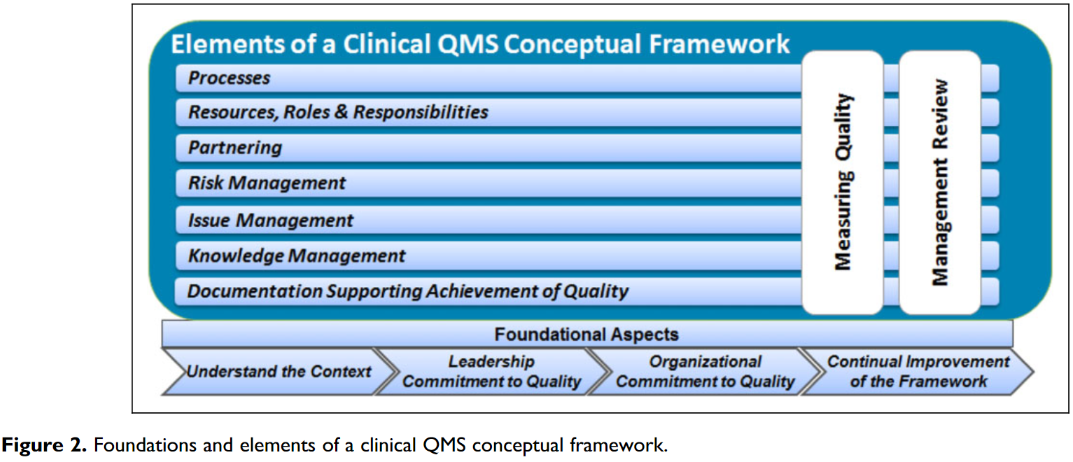
Components of the framework helps organization compartmentalize and deliver on the final vision and strategy. Key components within which we are foundational include:
- Understanding the context (Internal & External environments)
- Leadership Commitment to Quality (e.g., proactive risk mitigation)
- Organizational Commitment (e.g., ownership by everyone)
- Continuous Improvement (e.g., never satisfied with status quo)
https://journals.sagepub.com/doi/pdf/10.1177/2168479015596018
1.1.2.1.3.1 - Interlocking SIPOCs
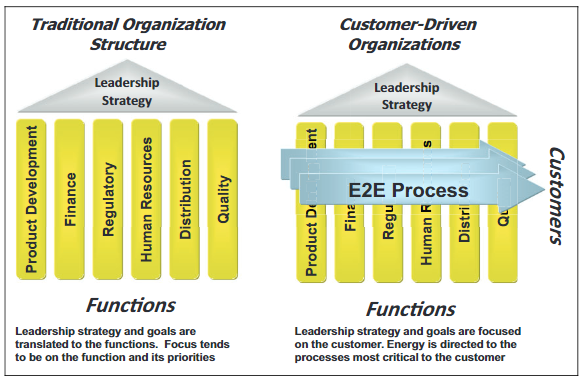
Process management is obviously important in any organization that is looking to achieve scalability and repeatability and thereby a strategy for building integrated processes at various levels of the organization is required. A method by which one can achieve these processes is through interlocking SIPOCs whereby the output of one process is the input of another process. In such a way, your creating a series of processes that can be linked into a graphical network thereby driving at transparency and clearly defined accountabilities. Within the community of knowledge management, this is done via linked data or semantic web.
Components of the framework
- Define and Characterize Processes (Processes at varying levels of the organization - See Interlocking SIPOCs)
- Determine Process Documentation strategy (Process map then documentation - digital workflows)
- Drive Flawless execution through a learning approach (drives at recording the actual process not just theoretical)
- Monitor and improve process performance (Digital signatures of volume, veracity, velocity need to be taken into account)
https://link.springer.com/content/pdf/10.1177/2168479018817751.pdf
1.1.2.1.3.2 - Knowledge Management
Knowledge management is probably one of the most difficult problems to tackle in this modern digital age for the shear volume, veracity, variety and velocity at which new content is generated makes it difficult to reassemble if deliberate actions for organization and tagging where not taken before hand. Fortunately there’s hope, for we’re not in this alone, literally the entire world is struggling with this problems and scientists, technologists, engineers and mathematicians (STEM) have been deliberately attacking this problem through the creation of art (visualizations) - thereby transforming STEM to STEAM.
Driving a knowledge management framework in an organization enables exchange of information between people and systems seamlessly and deliberately which enables:
- Lowers errors due to lack of data transcription (i.e., copy/paste)
- More repeatable and predictable outcomes leading to increased flexibility and agility for the business
- Ultimately drives innovation and continuous improvement practices within the ecosystem of systems and humans (i.e., get the systems working for humans not the other way around)
https://link.springer.com/content/pdf/10.1177/2168479016664773.pdf
1.1.2.1.3.3 - Risk Framework
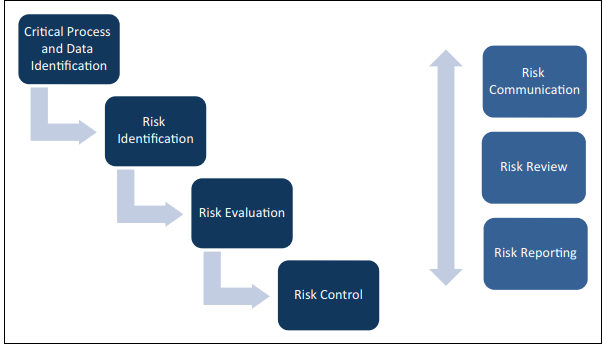
Risk management is a key term used across many organizations as an effective means to communicate broader sustained exposures to the organization and thereby drive a more end to end mindset focused upon the patients safety and efficacy. The critical component on establishing an effective risk management framework is following the entire 4 step process as outlined below.
The minimal requirements for an effective risk management methodology based on ICH E6(2):
- Critical Process and Data Identification (e.g., prior to identification of critical - you need to define the process itself - hence the homosapien bioreactor work)
- Risk Identification (arises from the tracking between process steps and quality attributes/KPI’s associated)
- Risk Evaluation (further refinement of risk identification for prioritization)
- Risk Control (defining the mechanisms you are going to take to control those risks)
https://link.springer.com/content/pdf/10.1177/2168479018817752.pdf
1.1.2.2 - Why You Must Keep Data Human-Readable — Even Years Later
When working in regulated environments — especially in life sciences — it’s not enough to just store your data. You must store it in a way that ensures it can be read, interpreted, and audited years down the line. This is more than a best practice — it’s a regulatory requirement.
What’s the Regulation?#
This requirement comes from 21 CFR Part 11, which governs electronic records and signatures. Specifically:
- 21 CFR 11.10(c) requires that records are “accurate and ready for retrieval” throughout their retention period.
- The FDA’s 2018 guidance on data integrity reinforces that if records are stored in non-human-readable or proprietary formats, companies must retain the software or system needed to render them readable.
If you save data in a format that only your application can read, you must keep that application around — or make sure the data is also available in a human-readable format.
This ensures that critical records don’t become inaccessible just because the original software is obsolete.
What About Global Regulations?#
This principle isn’t unique to the U.S. The EU GMP Annex 11 says the same:
“If the system is no longer supported, data should be migrated to a supported system or maintained in a way that is readable.”
In other words, accessibility, integrity, and readability over time are non-negotiable — even if your systems evolve.
What Should You Do?#
- Retain readable exports (e.g., PDFs, CSVs) alongside raw data whenever possible
- Document how to interpret data stored in custom or proprietary formats
- Keep legacy applications or emulators if needed, or plan for timely data migration
Bottom Line#
Regulations don’t just care that you kept the data — they care whether you (or an auditor) can actually understand it years later. If it’s locked away in a black box, you’re on shaky ground.
Need help aligning your records retention with regulatory expectations? Reach out to your compliance or quality team — or let us know how we can help.
1.1.3 - Control Strategies
Introduction to Control Strategy, Design Space, and Knowledge Space in Manufacturing#
In modern manufacturing, especially in regulated industries like pharmaceuticals, ensuring product quality is paramount. The International Conference on Harmonisation (ICH) introduced the concept of Quality by Design (QbD) to promote a more robust and scientific approach to product and process development. Central to QbD are the concepts of Control Strategy, Design Space, and Knowledge Space, which together ensure that manufacturing processes consistently produce high-quality products. Here’s a breakdown of these key elements:
Knowledge Space#
The Knowledge Space encompasses the full understanding of the product, the process, and the interaction between process parameters and product quality. It is derived from scientific research, prior knowledge, experimental data, and risk assessments. The Knowledge Space includes both known and unknown factors, as well as areas where more data is needed to reduce uncertainty.
In the context of QbD, developing a robust Knowledge Space means gathering comprehensive data on raw materials, process variables, and equipment characteristics to inform decisions on the design and optimization of the manufacturing process.
Design Space#
The Design Space is a subset of the Knowledge Space and represents the multidimensional range of input variables (e.g., temperature, pressure, flow rates) and process parameters that have been shown to provide assurance of product quality. Operating within the Design Space ensures that the process remains controlled and that the final product meets predefined quality criteria.
ICH Q8 defines the Design Space as “the multidimensional combination and interaction of input variables (e.g., material attributes) and process parameters that have been demonstrated to provide assurance of quality.” In practical terms, the Design Space allows flexibility in manufacturing processes as long as operations remain within this validated region.
Control Strategy#
The Control Strategy refers to the planned set of controls that ensure process performance and product quality. It is developed based on the understanding gained from the Knowledge Space and is applied to maintain operations within the boundaries of the Design Space. Control strategies may involve real-time monitoring, in-process testing, and quality control checks, ensuring that variations in critical process parameters are detected and managed promptly.
The Control Strategy ensures that even if there are small deviations, corrective actions can be taken to maintain product quality. It is a proactive approach to managing variability and mitigating risks.
Tying it All Together: Quality by Design (QbD)#
In the QbD framework, the Knowledge Space forms the foundation of understanding, helping to identify critical quality attributes and process parameters. The Design Space is then developed from this understanding, defining the safe and effective operating ranges for the process. Finally, a well-structured Control Strategy ensures that the process stays within the Design Space, maintaining product quality and compliance with regulatory requirements.
QbD moves away from the traditional quality approach of testing finished products and instead emphasizes building quality into the process through knowledge, design, and control. This ensures not only consistent product quality but also enhances process efficiency and flexibility, reducing the likelihood of process failures and minimizing the need for extensive post-approval changes.
skinparam rectangle {
  BackgroundColor white
  BorderColor black
  Shadowing false
}

rectangle "Knowledge Space" {
  rectangle "Design Space" {
    rectangle "Control Strategy"
  }
}
1.1.4 - Drug Development Process
Written by: Hector Fernandez
Edited by: Jina Zhou and Esther Melamed
6/4/2020
The past several months have seen a rapid development of new products, as well as the refurbishing of established treatments, in hopes of mitigating the ongoing COVID-19 outbreak. One remarkable feat of this race for a cure is the time it has taken to get several of the prophylaxis/treatment candidates to clinical trials.
Typically, it takes several years for products such as vaccines to be tested on human subjects. Today, several of the COVID-19 vaccine candidates in the market have gone to human testing within only a few months of initial testing. This, of course, has not come without criticisms and backlash from experts regarding possible safety issues that can result from such a short development time span.
The following article provides an overview of the drug development process in hopes of both informing the reader about what it takes to get a new drug product into the market as well as contrasting the typical timeline with that of COVID-19 candidate treatments.
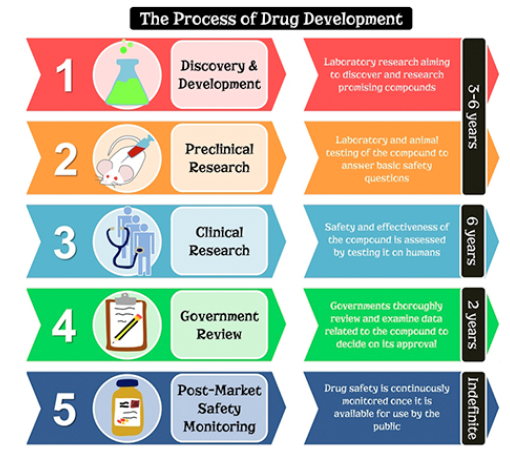
Figure 1 – Drug development process (illustration by Jennifer Harris)
What is drug development?
Drug development is the process that entities, more commonly pharmaceutical companies, have to go through in order to develop their products before they are made available for the public. In the United States, this process is regulated by the Food and Drug Administration (FDA). According to the FDA, the drug development process is broken down into five steps:
1. Discovery and Development
2. Preclinical Research
3. Clinical Research
4. FDA Review
5. FDA Post-Market Safety Monitoring
Discovery and Development
The initial process by which new medicines, such as vaccines, are developed can be broken down into the discovery and development phases.
Discovery
There are various routes by which a new medicine is discovered. Typically, the process of discovery begins after scientists, and other experts, learn of cellular targets involved in a biological process that are thought to be dysfunctional and cause disease (or in the case of infectious diseases, the detection of an invading pathogen). Cellular targets include cell receptors, enzymes, membranes, genes, etc. Depending on the disease in question, the manipulation of these processes, which can range from impeding, enhancing, or modifying molecular processes, are thought to lead to beneficial effects to treat the condition at hand.
Development
Once a new molecular entity (NME) is identified, the process of development can begin. In this step, scientists and clinicians conduct experiments to obtain information on the behavior of the NME in the body and its properties. Some of the key information gathered includes:
- Mechanism of action
- Potential benefits
- Effectiveness
- Pharmacodynamics (how the drug affects the body)
- Including how it affects different populations
- Pharmacokinetics
- How it is absorbed, distributed, metabolized, and excreted
- Best dose and route of administration
- Adverse effects
- Interaction with other treatments
Preclinical Research
Before an NME is tested in people it must go through a process to find out whether it is safe for use in humans. To do this, researchers build protocols to test these compounds in non-human models. The two types of pre-clinical research include in vitro, or outside a living organism such as in a test tube, and in vivo studies which involve studies done in living organisms. These studies, which are typically small, provide information on the toxicity profile of the NME. After preclinical studies are done, researchers analyze their findings and decide whether their product should be tested on people. At this point, entities can file an Investigational New Drug (IND) application to the FDA which must include all pertinent information including preclinical data, clinical protocols for studies that will be conducted, manufacturing information, and information regarding the investigator. The FDA review team has 30 days to review the original IND submission.
Clinical Research
After the FDA approves an IND submitted by a sponsor (i.e. entity developing the drug) clinical trials can begin. There are three clinical phase studies that take place before a drug gets approved, with each having its own purpose. A fourth phase is carried out after the product is approved by the FDA, which centers on the products safety and efficacy profile. The following table provides an overview of the different phases of clinical research.
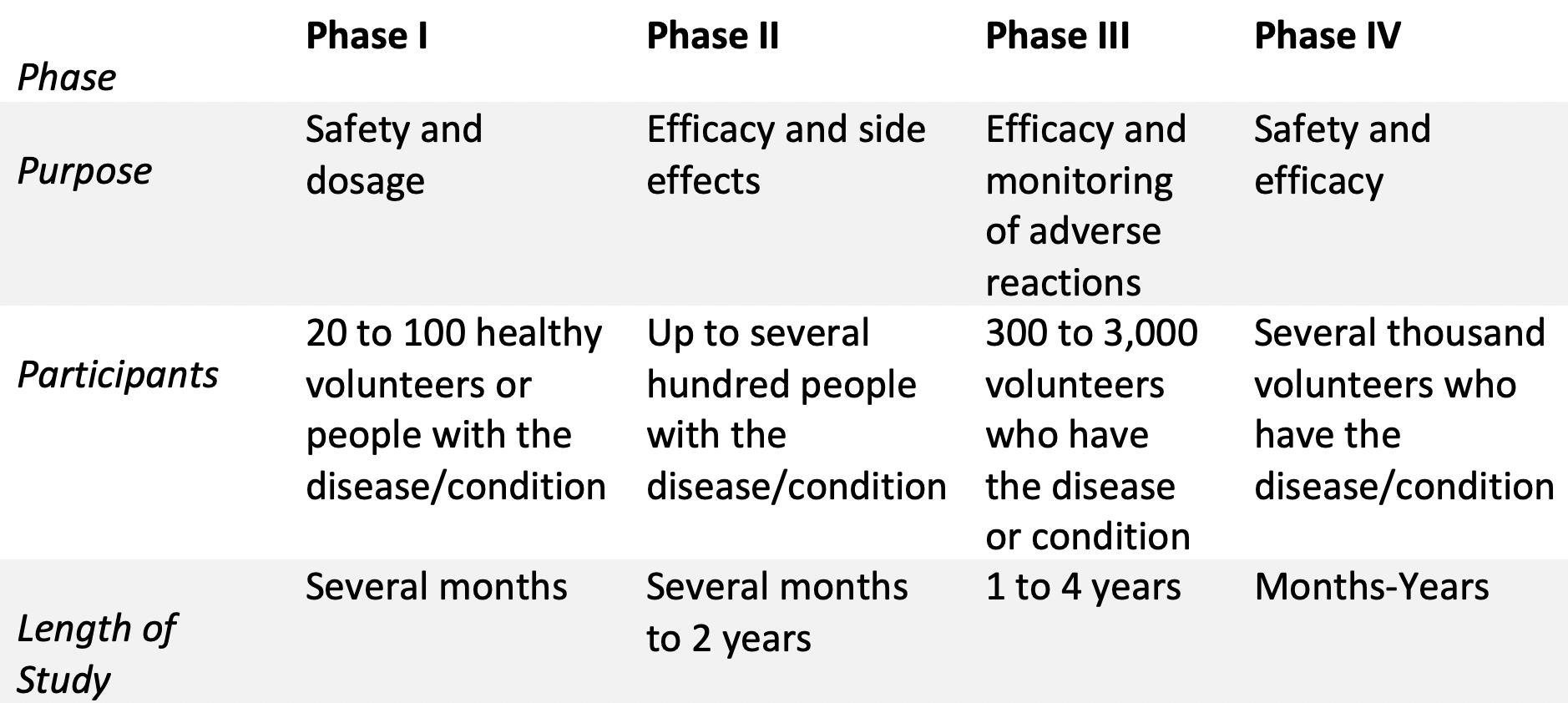
Table 1 – Summary of clinical research phase studies.
Fun facts:
• Approximately 70% of drug candidates move to phase II
• Approximately 33% of drug candidates move to phase III
• Approximately 25-30% of drug candidates move to phase IV
FDA Review
Once a sponsor has sufficient evidence from preclinical and clinical studies that their drug is safe and effective for its intended use, a New Drug Application (NDA) can be filed to the FDA for approval. An NDA contains all pertinent information regarding the use of the drug for the intended population. Some of the information contained within an NDA, along with clinical studies data, includes:
- Proposed labeling
- Safety updates
- Drug abuse information
- Patent information
- Any data from studies that may have been conducted outside the United States
- Institutional review board compliance information
- Directions for use
Once the FDA has received a complete NDA their review team has 6-10 months to decide whether to approve the new drug. If the NDA gets approved, the FDA works with the sponsor in a process called labeling. Labeling is a process by which an applicant develops or refines the prescribing information of their product. This process allows for an objective description of how to best use a new medication.
FDA Post-Market Safety Monitoring
Although the drug development process provides important information about a drug’s safety and efficacy profile, it is very difficult to gather all information regarding the new drug product at the time of approval. Thus, the complete picture regarding the drug safety profile will evolve over time as the product enters the market. To address this, the FDA has developed several programs, such as MedWatch and MedSun, where patients, health professionals, and manufacturers can report any problems that may arise with an approved product. Once problems are noted with any approved drug, the FDA will review each case and take measures to mitigate any safety issues such as adding cautions to the usage information.
Sources
1. The drug development process. (2018, January 4). U.S. Food and Drug Administration. https://www.fda.gov/patients/learn-about-drug-and-device-approvals/drug-development-process
2. Vaccine testing and approval process | CDC. (2019, April 5). Centers for Disease Control and Prevention. https://www.cdc.gov/vaccines/basics/test-approve.html
3. Mohs, R. C., & Greig, N. H. (2017). Drug discovery and development: Role of basic biological research. Alzheimer’s & dementia (New York, N. Y.), 3(4), 651–657. https://doi.org/10.1016/j.trci.2017.10.005
4. Help. (n.d.). Home – ClinicalTrials.gov. https://www.clinicaltrials.gov/ct2/help/glossary/phase
5. What are the different types of clinical research? (2018, January 4). U.S. Food and Drug Administration. https://www.fda.gov/patients/clinical-trials-what-patients-need-know/what-are-different-types-clinical-research
6. The basics. (2017, October 20). National Institutes of Health (NIH). https://www.nih.gov/health-information/nih-clinical-research-trials-you/basics
7. Van Norman, Gail A., 2016. Drugs, devices, and the FDA: Part 1. An overview of the approval process. JACC: Basic Transl. Sci. 1 (3),170–179. https://doi.org/10.1016/j.jacbts.2016.03.002
1.2 - Scientific Method in Digital Age
Scientific Method in the Digital Age#
The core principles of the scientific method—asking questions, forming hypotheses, designing experiments, collecting data, and sharing results—remain unchanged. However, in the digital era, how we document, analyze, and communicate our work must evolve to ensure research is transparent, reproducible, and collaborative.
Inspired by The Turing Way, this section explores methodologies and best practices for reproducible research in pharmaceutical science. The Turing Way emphasizes that reproducibility is not just a technical challenge, but a cultural one, requiring open tools, clear documentation, and inclusive collaboration.
Digital Tools Should Empower, Not Restrict#
Just as you wouldn’t store your money in a bank that makes it hard to withdraw, you shouldn’t use digital tools that lock away your data. Choose platforms and software that support open standards, easy export, and sharing—ensuring your research remains accessible and reusable.
The Problem#
Traditionally, scientists have relied on paper notebooks for discovery and documentation. In the digital age, however, research data and workflows are often managed as “IT problems,” disconnected from the scientific process. This can lead to fragmented records, poor reproducibility, and barriers to collaboration.
Mitigation#
We aim to educate scientists and engineers on digital methods and trends that support the entire research lifecycle:
- Use open-source, community-driven tools for data collection, analysis, and sharing.
- Document every step of your process, from hypothesis to publication, in a way that others can understand and reproduce.
- Adopt version control, automation, and collaborative platforms to streamline teamwork and transparency.
Design Decisions#
To ensure global scalability and long-term accessibility:
- Every recommended tool must meet open-source criteria.
- Workflows should be designed for interoperability, transparency, and ease of use.
- Documentation and code should be shared in public repositories whenever possible.
By aligning with the principles of The Turing Way, we can foster a culture of reproducible, open, and collaborative science—accelerating discovery and ensuring that our work benefits the broader scientific community.
1.2.1 - Critical Question
The Role of Critical Questions in Pharmaceutical Development#
Every successful pharmaceutical product begins with a set of critical questions. These questions guide the scientific method and shape each phase of development, from early discovery through to commercial manufacturing and patient delivery. Identifying and answering these questions is essential to ensure that medicines are not only safe and effective, but also manufacturable at scale and accessible to patients.
Phase 1: Is It Safe and Efficacious?#
The first and most fundamental questions in drug development focus on patient safety and therapeutic benefit:
- Is the drug candidate safe for human use?
- Does it demonstrate the intended efficacy in preclinical and clinical studies?
- What are the potential risks, side effects, and contraindications?
- How do process parameters and material attributes impact the critical quality attributes (CQAs) of the final product?
- How does the scale of my process impact the performance and reproducibility of the product?
- What is the stability of my form and formulations over time and under various conditions?
Phase 2: Can We Manufacture and Deliver It Efficiently?#
Once safety and efficacy are established, the focus shifts to practical and economic considerations:
- Can the product be manufactured consistently and at high quality?
- What are the key cost drivers in the manufacturing process?
- How can we optimize the process to reduce costs without compromising quality or compliance?
- Are there supply chain or distribution challenges that could impact patient access?
- How do we ensure scalability from clinical to commercial production?
- What regulatory requirements must be met for global distribution?
The Ongoing Cycle#
Critical questions do not end once a product reaches the market. Continuous improvement, post-market surveillance, and lifecycle management all depend on asking and answering new questions as knowledge, technology, and patient needs evolve.
Examples of Critical Questions#
- How do process parameters and material attributes impact my final product quality attributes?
- How does the scale of my process impact the performance of the process?
- What is the stability of my form and formulations?
- What are the most significant risks to patient safety and how can they be mitigated?
- How can manufacturing be optimized to ensure both quality and cost-effectiveness?
- What strategies will ensure reliable delivery and patient access worldwide?
By systematically addressing these critical questions at each stage, pharmaceutical teams can develop products that are not only innovative and effective, but also practical to manufacture and deliver—ultimately ensuring that patients receive the therapies they need.
1.2.2 - Design
Design Thinking#
A design thinking approach is essential for clearly defining the outcomes you aim to achieve in pharmaceutical research and manufacturing. This phase is about being prescriptive and intentional—identifying the business value, reviewing historical knowledge, and determining what gaps must be filled to move forward.
Scoping projects during the design phase is critical. It allows teams to “dare to dream” and innovate, while ensuring that every experiment or process improvement is grounded in a clear understanding of context. In manufacturing, this context is often captured through material genealogy—the detailed record of how materials and processes are linked throughout production.
Understanding and documenting this genealogy is foundational for reproducibility, traceability, and process optimization. For a deeper dive into the importance of material genealogy in manufacturing, see this background paper: 2012-batch-genealogy-justin-neway.pdf
1.2.3 - Data Collection
Effective data collection is the backbone of scientific progress in pharmaceutical research and manufacturing. To answer the critical question, teams must gather both historical and new data, building a robust foundation for process knowledge and understanding (PKU).
Data collection is not just about amassing information—it’s about ensuring that the right data is captured, in the right format, and with the right context. This enables meaningful analysis, supports regulatory compliance, and drives continuous improvement.
Key considerations for data collection include:
- Defining Data Needs: What specific data is required to address your scientific or operational question? This may include process parameters, material attributes, environmental conditions, and outcomes.
- Historical Data Mining: Leveraging existing datasets can reveal trends, variability, and potential risks. However, legacy data may be incomplete or inconsistent, requiring careful curation and validation.
- Designing New Experiments: When gaps exist, targeted experiments should be designed to generate high-quality, reproducible data. This includes clear protocols, standardized measurements, and rigorous documentation.
- Data Integrity and Traceability: Ensuring data is accurate, complete, and attributable is essential for both scientific validity and regulatory compliance (see ALCOA+ principles).
- Integration and Accessibility: Data should be stored in interoperable formats and systems that facilitate sharing, analysis, and long-term access.
For a deeper exploration of these concepts and practical strategies for building process knowledge and understanding, see this paper by Fermier & Higgins (2018), which discusses the challenges and best practices in pharmaceutical data collection and PKU.
1.2.4 - Aggregation
Aggregation Strategies Come in Many Shapes and Sizes#
Once data has been collected, it often exists in a variety of formats—PDFs, CSVs, Excel files, databases, and more. The challenge is to bring this disparate information together in a way that enables meaningful analysis, supports decision-making, and maintains data integrity.
Aggregation is not a one-size-fits-all process. The optimal strategy depends on your goals, available resources, and the complexity of your data landscape. The focus should always be on fit-for-purpose approaches that optimize speed, cost, and quality.
Key Considerations for Data Aggregation#
- Conformance to a Common Data Model: Standardizing data into a unified structure is essential for downstream analytics, regulatory submissions, and reproducibility.
- Data Cleaning and Transformation: Raw data often requires cleaning, normalization, and transformation to ensure consistency and usability.
- Automation vs. Manual Integration: Automated pipelines can accelerate aggregation and reduce errors, but manual curation may be necessary for complex or legacy datasets.
- Documentation and Traceability: Every step in the aggregation process should be well-documented to ensure transparency and reproducibility.
Recipe-Based Approach#
Our recommended strategy is to follow a recipe-based approach, which provides a structured, repeatable method for aggregating and transforming data. This approach emphasizes modularity, transparency, and adaptability—key principles for robust data management in pharmaceutical research and manufacturing.
For a detailed discussion and practical examples, see the following paper:
1.2.5 - Analysis
Analysis is the phase where data becomes actionable insight. In pharmaceutical research and manufacturing, analytical methods span a broad spectrum—from foundational statistical techniques to cutting-edge machine learning and artificial intelligence.
Statistical Process Control (SPC)#
At its core, analysis in pharma often begins with Statistical Process Control (SPC). SPC uses statistical methods to monitor and control processes, ensuring that manufacturing remains consistent and within defined quality limits. Key tools include:
- Control charts for tracking process stability
- Capability analysis to assess whether a process meets specifications
- Trend analysis for early detection of deviations
SPC is essential for maintaining product quality, meeting regulatory requirements, and driving continuous improvement.
Multivariate Analysis and Chemometrics#
As processes and data become more complex, multivariate analysis techniques—such as Principal Component Analysis (PCA) and Partial Least Squares (PLS)—help uncover relationships among multiple variables. These methods are widely used in:
- Process optimization
- Root cause analysis
- Real-time process monitoring (PAT)
Advanced Analytics and Machine Learning#
With the explosion of data in pharma, advanced analytics and machine learning (ML) are transforming how we extract value from information. Applications include:
- Predictive modeling for process outcomes and product quality
- Anomaly detection to identify rare events or out-of-spec results
- Automated image analysis in quality control and pathology
- Natural language processing for mining scientific literature and regulatory documents
Machine learning models can learn from historical and real-time data, enabling proactive decision-making and process automation. However, successful deployment requires careful attention to data quality, model validation, interpretability, and regulatory compliance.
The Future: AI-Driven Pharma#
Artificial intelligence (AI) is poised to further accelerate drug discovery, development, and manufacturing. From generative models for molecule design to digital twins of manufacturing processes, AI is opening new frontiers in pharmaceutical science.
By combining foundational statistical methods with advanced analytics and AI, the pharmaceutical industry can achieve greater efficiency, quality, and innovation—ultimately delivering better outcomes for patients and society.
1.2.6 - Reporting
The Importance of Reporting#
Reporting is the final, critical phase of the scientific and manufacturing process. It transforms data, analysis, and insights into a structured narrative that communicates findings, supports decision-making, and ensures compliance with regulatory requirements.
Key Aspects of Effective Reporting#
- Transparency: Reports should clearly document methods, data sources, analyses, and results, enabling others to understand and reproduce the work.
- Regulatory Compliance: In pharmaceuticals, reporting must meet stringent standards set by regulatory agencies (e.g., FDA, EMA, ICH). This includes traceability, data integrity, and adherence to guidelines such as 21 CFR Part 11.
- Audience Awareness: Reports should be tailored to their audience—scientists, engineers, management, or regulators—highlighting relevant details and actionable insights.
- Data Visualization: Effective use of tables, charts, and graphics can make complex data more accessible and support better decision-making.
- Archiving and Accessibility: Reports must be stored securely and remain accessible for audits, inspections, and future reference.
Digital Reporting and Automation#
Modern reporting leverages digital tools to automate data extraction, analysis, and formatting. Automated reporting systems can:
- Reduce manual errors and save time
- Ensure consistency across reports
- Facilitate real-time dashboards and alerts
Reproducibility and Open Science#
Following principles from The Turing Way, reproducible reporting means sharing not just results, but also the underlying data, code, and workflows. This fosters trust, accelerates innovation, and enables collaboration across the scientific community.
Effective reporting closes the loop in the scientific method—turning research and manufacturing data into knowledge that drives progress, compliance, and better outcomes
2 - Knowledge Management: The Strategic Foundation of Research
Knowledge Management is a key revenue source as it helps ensure you do not repeat what others may know and ensures you are spending the scarce resources you have in the most effective manner.
It does NOT happen automatically. Organizations need to take deliberate action to manage what they know and organize it in a manner that others in the areas of research can find and quickly learn and add their knowledge to this structured approach.
The Knowledge Management Lifecycle#
Effective knowledge management follows a continuous cycle that transforms information into actionable insights and organizational capability:
@startuml
!theme plain
skinparam backgroundColor white
skinparam activity {
  BackgroundColor lightblue
  BorderColor darkblue
  FontColor black
}
skinparam arrow {
  Color darkblue
}

start
:Search Existing Knowledge;
note right
  - Literature review
  - Internal databases
  - Expert consultation
  - External repositories
end note

:Perform Gap Analysis;
note right
  - Identify knowledge gaps
  - Assess criticality
  - Prioritize needs
  - Resource evaluation
end note

if (Knowledge Gap Exists?) then (yes)
  :Design Knowledge Acquisition Strategy;
  note right
    - Experiment design
    - Collaboration planning
    - Resource allocation
    - Timeline establishment
  end note

  :Execute Knowledge Generation;
  note right
    - Run experiments
    - Collect data
    - Analyze results
    - Validate findings
  end note

  :Capture & Document New Knowledge;
  note right
    - Structure findings
    - Create documentation
    - Peer review
    - Quality assurance
  end note

else (no)
  :Apply Existing Knowledge;
  note right
    - Use established methods
    - Adapt to context
    - Document application
  end note
endif

:Integrate into Knowledge Base;
note right
  - Update repositories
  - Cross-reference
  - Tag and categorize
  - Version control
end note

:Share & Disseminate;
note right
  - Internal communication
  - External publication
  - Training materials
  - Best practices
end note

:Monitor & Evaluate Impact;
note right
  - Usage metrics
  - Feedback collection
  - Outcome assessment
  - ROI measurement
end note

:Continuous Improvement;
note right
  - Process refinement
  - System updates
  - Training enhancement
  - Tool optimization
end note

stop
@enduml
Core Components of Effective Knowledge Management#
1. Knowledge Discovery and Inventory#
Before generating new knowledge, organizations must systematically discover what already exists:
- Internal Knowledge Audit: Catalog existing expertise, documents, data, and processes
- External Landscape Analysis: Map relevant knowledge in academic literature, industry reports, and competitor intelligence
- Expert Networks: Identify and connect with internal and external subject matter experts
- Institutional Memory: Capture tacit knowledge from experienced practitioners
2. Gap Analysis and Prioritization#
Strategic knowledge management requires understanding not just what you know, but what you need to know:
- Strategic Alignment: Ensure knowledge priorities support organizational objectives
- Risk Assessment: Identify critical knowledge gaps that pose operational or competitive risks
- Resource Optimization: Balance knowledge acquisition costs against potential benefits
- Timeline Considerations: Prioritize urgent knowledge needs while building long-term capabilities
3. Knowledge Acquisition Strategies#
Different types of knowledge gaps require different acquisition approaches:
- Experimental Research: Generate new knowledge through controlled studies and investigations
- Collaborative Learning: Partner with external organizations to share and develop knowledge
- Technology Transfer: Acquire knowledge through licensing, consulting, or talent acquisition
- Systematic Learning: Implement structured programs to build organizational capabilities
4. Knowledge Capture and Codification#
Raw information becomes valuable knowledge only when properly structured and documented:
- Documentation Standards: Establish consistent formats for capturing different types of knowledge
- Metadata Management: Ensure knowledge assets are properly tagged and categorized for discovery
- Version Control: Track the evolution of knowledge and maintain historical context
- Quality Assurance: Implement review processes to ensure accuracy and reliability
5. Knowledge Sharing and Transfer#
Knowledge creates value only when it reaches those who can apply it effectively:
- Accessible Repositories: Create searchable databases and knowledge bases
- Communities of Practice: Foster networks where practitioners can share insights and learn from each other
- Training Programs: Develop systematic approaches to transfer knowledge to new team members
- Decision Support: Integrate knowledge into workflows and decision-making processes
The Digital Advantage in Knowledge Management#
Modern digital tools have transformed knowledge management capabilities:
Automated Knowledge Discovery#
- AI-Powered Search: Use natural language processing to find relevant knowledge across diverse sources
- Pattern Recognition: Identify connections and trends that might not be obvious to human analysts
- Real-Time Monitoring: Track emerging knowledge in your field through automated literature reviews and alerts
Enhanced Collaboration#
- Virtual Teams: Enable knowledge sharing across geographic and organizational boundaries
- Collaborative Platforms: Facilitate collective knowledge creation and refinement
- Expert Networks: Connect knowledge seekers with relevant experts regardless of location
Intelligent Organization#
- Semantic Tagging: Use AI to automatically categorize and tag knowledge assets for faster discovery
2.1 - From Trenches to Transformation: How Design Study Methodology Can Accelerate Knowledge Evolution in 2025
In 2012, Michael Sedlmair, Miriah Meyer, and Tamara Munzner published what would become a foundational paper in visualization research: “Design Study Methodology: Reflections from the Trenches and the Stacks.” More than a decade later, their systematic approach to problem-driven research offers profound insights that extend far beyond visualization into the broader challenge of knowledge evolution in our rapidly changing world.
The Original Vision: Nine Stages of Systematic Discovery#
The authors’ methodology emerged from reflecting on twenty-one design studies and extensive literature review. Their framework consists of nine carefully orchestrated stages: learn, winnow, cast, discover, design, implement, deploy, reflect, and write. What makes this approach revolutionary isn’t just its systematic nature, but its recognition that knowledge creation is inherently iterative and collaborative.
The “trenches” represent the messy, real-world challenges researchers face when working with domain experts. The “stacks” symbolize the accumulated knowledge in academic literature. The methodology bridges these two worlds, creating a structured pathway for transforming practical problems into generalizable knowledge.
The Knowledge Evolution Challenge#
Traditional research often follows a linear path: identify problem, review literature, develop solution, publish results. But this approach struggles with the complexity of modern challenges. Climate change, artificial intelligence ethics, healthcare disparities, and technological disruption require more agile, collaborative approaches to knowledge creation.
The design study methodology anticipated this need by emphasizing:
- Iterative learning cycles that allow researchers to adapt as understanding deepens
- Cross-domain collaboration that breaks down silos between disciplines
- Systematic reflection that extracts transferable insights from specific contexts
- Practical deployment that tests knowledge in real-world conditions
Reimagining the Framework for 2025#
As we navigate an era of unprecedented technological change, the core principles of design study methodology become even more relevant. Here’s how we can adapt this framework for 2025’s unique challenges:
1. Learn → Continuous Learning Networks#
The traditional “learn” phase focused on understanding a specific domain. In 2025, we need continuous learning networks that span multiple domains simultaneously. With AI assistance, researchers can maintain awareness of developments across fields, identifying unexpected connections and emerging patterns.
2025 Opportunity: Create AI-powered research assistants that continuously scan literature, identify emerging trends, and suggest novel cross-domain connections. These systems could flag when developments in one field might impact another, accelerating interdisciplinary insights.
2. Winnow → Adaptive Filtering#
The original “winnow” stage involved narrowing focus to manageable scope. Today’s challenges require adaptive filtering that can dynamically adjust scope based on emerging insights and changing conditions.
2025 Opportunity: Develop adaptive research frameworks that can pivot quickly when new information emerges. This might involve scenario planning approaches where multiple research threads are maintained simultaneously, allowing teams to shift focus as circumstances change.
3. Cast → Diverse Stakeholder Ecosystems#
“Cast” originally meant assembling the right team. In 2025, we need diverse stakeholder ecosystems that include not just domain experts and researchers, but also affected communities, policymakers, and implementation partners from the outset.
2025 Opportunity: Design participatory research platforms that enable broader stakeholder engagement throughout the research process. This could include citizen science components, community feedback loops, and policy maker integration sessions.
4. Discover → Accelerated Insight Generation#
The “discover” phase identified key insights and abstraction opportunities. Modern tools enable accelerated insight generation through AI-assisted pattern recognition, automated hypothesis generation, and real-time data analysis.
2025 Opportunity: Implement AI-human collaboration systems that can process vast amounts of data to identify patterns humans might miss, while maintaining human oversight for contextual interpretation and ethical considerations.
5. Design → Rapid Prototyping Ecosystems#
Traditional design phases often took months or years. 2025 demands rapid prototyping ecosystems that can quickly test multiple approaches simultaneously using simulation, digital twins, and AI-generated alternatives.
2025 Opportunity: Create collaborative design platforms where researchers worldwide can contribute to and iterate on solutions in real-time, using shared simulation environments and standardized testing protocols.
6. Implement → Agile Knowledge Deployment#
Implementation traditionally meant building specific tools or systems. Modern implementation requires agile knowledge deployment strategies that can adapt to different contexts and scale across diverse environments.
2025 Opportunity: Develop modular knowledge frameworks that can be rapidly adapted and deployed across different contexts, with built-in monitoring and adaptation mechanisms.
7. Deploy → Living Laboratory Networks#
Deployment once meant releasing a finished product. Today’s complex challenges require living laboratory networks where solutions continuously evolve based on real-world performance and changing conditions.
2025 Opportunity: Establish global networks of living laboratories that share data, insights, and adaptations in real-time, creating a collective learning system that accelerates knowledge evolution.
8. Reflect → Continuous Meta-Learning#
The reflection stage extracted lessons learned. Modern reflection requires continuous meta-learning that not only captures insights from individual projects but also identifies patterns across multiple studies and domains.
2025 Opportunity: Build AI-assisted reflection systems that can analyze patterns across thousands of research projects, identifying successful strategies, common pitfalls, and emergent best practices.
9. Write → Dynamic Knowledge Artifacts#
Traditional writing produced static papers. 2025 demands dynamic knowledge artifacts that can evolve as new insights emerge and adapt to different audiences and contexts.
2025 Opportunity: Create interactive knowledge platforms where research findings are presented as living documents that can incorporate new data, respond to questions, and adapt their presentation based on the reader’s background and needs.
The Compound Effect: Accelerating Knowledge Evolution#
When these enhanced stages work together, they create a compound effect that could dramatically accelerate knowledge evolution. Instead of isolated research projects producing incremental insights, we could have interconnected networks of adaptive research systems that:
- Share insights in real-time across disciplines
- Adapt quickly to emerging challenges
- Involve diverse stakeholders throughout the process
- Generate solutions that can be rapidly deployed and evolved
- Learn from each other’s successes and failures
Practical Steps for 2025#
Organizations and researchers can begin implementing these ideas immediately:
For Research Institutions:
- Invest in AI-powered research assistance tools
- Create interdisciplinary collaboration platforms
- Establish partnerships with implementation organizations
- Develop rapid prototyping capabilities
For Funding Agencies:
- Support longer-term, adaptive research programs
- Encourage cross-domain collaboration
- Fund living laboratory networks
- Prioritize projects with built-in reflection and learning mechanisms
For Individual Researchers:
- Develop skills in AI-assisted research methods
- Build diverse collaborative networks
- Practice rapid prototyping approaches
- Engage with implementation communities early and often
The Future of Knowledge Creation#
The design study methodology showed us that systematic approaches to knowledge creation can bridge the gap between theory and practice. As we face increasingly complex global challenges, these principles become even more crucial.
The future of knowledge evolution isn’t just about creating new information—it’s about creating adaptive systems that can learn, evolve, and respond to changing conditions. By building on the solid foundation that Sedlmair, Meyer, and Munzner established, we can create research methodologies that are worthy of the challenges we face.
The trenches of 2025 may be digital, global, and interconnected, but the fundamental need for systematic, collaborative, and reflective approaches to knowledge creation remains unchanged. What has changed is our capacity to implement these approaches at unprecedented scale and speed.
The question isn’t whether we can evolve our knowledge creation processes—it’s whether we can do it fast enough to keep pace with the challenges ahead. The design study methodology provides both the foundation and the inspiration for this vital transformation.
2.2 - Ontological Semantics
Architecture of Ontological Semantics#
The key components required to build a knowledge framework leveraging Ontological Semantics — the theoretical grounding that has enabled the current field of Large Language Models — which help us create knowledge out of existing sources in a systematic manner.
@startuml
!theme plain
skinparam defaultFontSize 13
skinparam component {
  BackgroundColor #EBF5FB
  BorderColor #2980B9
  FontColor #1A252F
  RoundCorner 10
}
skinparam database {
  BackgroundColor #FEF9E7
  BorderColor #F39C12
}
skinparam rectangle {
  BackgroundColor #EAFAF1
  BorderColor #27AE60
  RoundCorner 8
}
skinparam arrow {
  Color #2C3E50
  FontColor #555
  FontSize 11
}

title Architecture of Ontological Semantics

package "Static Knowledge Sources" {
  database "Ontology\n(World Model)" as ONT
  database "Fact Repository\n(Domain Facts)" as FACT
  database "Lexicon\n(Word Forms & Meanings)" as LEX
  database "Onomasticon\n(Named Entities)" as ONOM
}

component "Knowledge Representation\nLanguage" as KRL

rectangle "Semantic Analyzer\n(Large Language Model)" as LLM

rectangle "Use Cases" as UC {
  component "Text Summarization" as TS
  component "Question & Answering" as QA
  component "AI Agents" as AG
}

ONT --> KRL : "defines concepts"
FACT --> KRL : "instantiates"
LEX --> KRL : "maps words → meaning"
ONOM --> KRL : "resolves named entities"

KRL --> LLM : "structured meaning\nrepresentation"

LLM --> TS
LLM --> QA
LLM --> AG
@enduml
The Four Static Knowledge Sources#
Ontology — the World Model#
The ontology defines the concepts that exist in a domain and the relationships between them. It is the schema of the knowledge graph: what nodes (concepts) and edge types (relationships) are valid. Without an ontology, a knowledge base is just a bag of facts with no shared meaning.
Fact Repository#
Stores instantiated knowledge — specific, asserted facts about the world derived from texts, experiments, or expert input. Facts are the populated rows of the ontology’s schema.
Lexicon#
Maps surface word forms to their semantic meanings. A lexicon allows the system to recognize that “kinase inhibitor,” “enzyme blocker,” and “phosphorylation suppressor” may all refer to the same ontological concept, enabling robust natural language understanding across varied terminology.
Onomasticon#
A specialized lexicon for named entities: people, organizations, places, products, and standards (e.g., “ICH Q10,” “S88,” “FDA”). The onomasticon lets the system resolve ambiguous proper nouns to canonical knowledge graph nodes.
Knowledge Representation Language#
The Knowledge Representation Language (KRL) is the formal grammar that ties the four sources together. It allows a system to derive meaning from raw text by:
- Parsing surface language through the Lexicon
- Resolving named entities through the Onomasticon
- Grounding concepts against the Ontology
- Asserting new facts into the Fact Repository
This pipeline is what transforms unstructured text into structured, queryable knowledge graph entries.
Semantic Analyzer — Large Language Models#
The Semantic Analyzer uses the KRL-structured knowledge to drive user-facing interactions. Modern LLMs play this role, but a key distinction applies:
@startuml
!theme plain
skinparam defaultFontSize 13
skinparam rectangle {
  RoundCorner 10
  FontColor white
}

rectangle "**Black Box LLM**\n(no visible ontology)\n\nGenerates answers\nCannot explain reasoning\nKnowledge is opaque" as BB #C0392B
rectangle "**Glass Box (Ontological Semantics)**\n(explicit ontology + fact repository)\n\nGenerates answers\nCan cite sources\nKnowledge is auditable" as GB #27AE60

BB -right[hidden]-> GB
note bottom of BB : Hallucination risk\nLow traceability
note bottom of GB : Ontology-grounded\nHigh explainability
@enduml
The Glass Box advantage is critical in regulated domains like pharma, manufacturing, and clinical research — where every knowledge claim must be traceable to its source.
Supported Use Cases#
| Use Case | How Ontological Semantics Helps |
|---|---|
| Text Summarization | Extracts key ontology nodes and relationships from documents, producing summaries that preserve semantic fidelity |
| Question & Answering | Grounds answers in the Fact Repository and Ontology rather than statistical patterns alone |
| AI Agents | Agents navigate the knowledge graph to plan multi-step reasoning, with each hop traceable to an ontology edge |
| Ontology Alignment | Maps domain-specific standards (S88, S95, ICH) to a shared ontology for interoperability |
Applied Example: This Site’s Taxonomy as an Ontology#
The STEAM knowledge graph on this site is itself an instance of ontological semantics in practice:
- Ontology nodes: Science, Technology, Engineering, Arts, Mathematics
- Ontology edges:
enables,implements,models,formalized by,grounded in - Lexicon: tags and categories on each page
- Onomasticon: persona names, standard names (ICH, S88, S95)
- Fact Repository: each page’s
related_conceptsfrontmatter
See the full graph: STEAM Knowledge Graph →
2.2.1 - Paper on Glass: Digital Process Data Capture with S88/S95 Ontology Alignment
Abstract#
The “paper on glass” paradigm represents a transformative approach to industrial process documentation, where traditional paper-based records are digitally replicated while maintaining familiar workflows. This paper explores how such systems can be enhanced through alignment with established manufacturing ontologies, specifically ISA-88 (S88) batch control and ISA-95 (S95) enterprise-control integration standards, creating a unified framework for recipe management and process data capture.
Introduction#
Manufacturing industries have long relied on paper-based documentation for recipe management, batch records, and process data collection. The “paper on glass” concept digitizes these familiar interfaces while preserving the cognitive patterns operators have developed over decades. However, true digital transformation requires more than visual replication—it demands semantic alignment with standardized ontologies that enable interoperability, data consistency, and automated processing.
The Paper on Glass Experience#
Visual Familiarity with Digital Power#
The paper on glass interface maintains the visual metaphors of traditional documentation:
- Form-based layouts that mirror paper worksheets
- Signature fields and approval workflows
- Checkbox lists and manual data entry points
- Familiar navigation patterns and information hierarchy
However, beneath this familiar surface lies a sophisticated data model that captures not just values, but semantic meaning, relationships, and process context.
Contextual Data Capture#
Unlike simple form digitization, true paper on glass systems capture:
- Temporal context: When actions occurred relative to process phases
- Causal relationships: How parameters influence outcomes
- Operational context: Who performed actions and under what conditions
- Equipment state: The configuration and status of process equipment
- Material genealogy: Traceability of inputs through transformation
S88 Ontology Integration#
Recipe Hierarchy Alignment#
The S88 standard defines a clear hierarchy for batch processes:
Recipe Level → Procedure → Unit Operation → Operation → Phase
Paper on glass systems aligned with S88 map traditional recipe cards to this structure:
- Master Recipe: The idealized process definition
- Control Recipe: Site-specific adaptation with equipment bindings
- Batch Record: Execution instance with actual parameters and results
Procedural Control Elements#
S88’s procedural control elements provide semantic structure for recipe steps:
- Phases become interactive workflow steps in the digital interface
- Operations group related phases with clear start/end conditions
- Unit Operations align with equipment modules and process cells
- Procedures represent complete processing sequences
Equipment Entity Modeling#
The S88 equipment model maps directly to paper on glass interfaces:
- Process Cells become top-level organizational units
- Units correspond to major equipment systems
- Equipment Modules represent controllable subsystems
- Control Modules map to individual instruments and actuators
S95 Enterprise Integration#
Functional Hierarchy#
S95 defines four levels of manufacturing operations:
- Level 4: Business planning and logistics
- Level 3: Manufacturing operations management
- Level 2: Supervisory control
- Level 1: Basic control
Paper on glass systems typically operate at Levels 2-3, bridging operator interfaces with enterprise systems.
Information Models#
S95 information models provide structure for:
- Work Orders: Linking recipes to production schedules
- Material Definitions: Standardizing ingredient and product specifications
- Equipment Information: Maintaining asset hierarchies and capabilities
- Production Performance: Capturing efficiency and quality metrics
Activity Models#
S95 activity models define standard operations:
- Production Scheduling: Translating demand into executable recipes
- Production Dispatching: Assigning resources to batch executions
- Production Execution: Real-time monitoring and control
- Production Tracking: Historical analysis and compliance reporting
Unified Recipe Management Framework#
Recipe as Executable Specification#
When aligned with S88/S95 ontologies, recipes become more than instructions—they become executable specifications that:
- Define precise control sequences
- Specify material requirements and constraints
- Establish quality checkpoints and acceptance criteria
- Enable automatic equipment configuration
- Support predictive quality modeling
Semantic Data Binding#
The ontological alignment enables semantic data binding where:
- Process parameters are linked to their physical measurements
- Material additions are tracked through inventory systems
- Quality attributes are connected to analytical results
- Deviations trigger defined response procedures
- Historical data supports continuous improvement
Cross-Recipe Learning#
Standardized ontologies enable learning across recipes:
- Common phases can share optimization insights
- Material properties influence multiple formulations
- Equipment performance patterns apply across products
- Quality correlations span recipe families
Implementation Architecture#
Ontology Layer#
The foundation consists of:
- S88 Process Model: Defining procedural hierarchy and equipment entities
- S95 Information Model: Structuring materials, personnel, and equipment data
- Domain Extensions: Industry-specific concepts and relationships
- Semantic Mappings: Linking legacy data to standardized concepts
Data Capture Layer#
This layer provides:
- Contextual Forms: Paper-like interfaces with semantic data binding
- Workflow Engine: S88-compliant procedure execution
- Real-time Integration: Connecting to process control systems
- Validation Rules: Ensuring data quality and compliance
Analytics Layer#
Advanced capabilities include:
- Process Mining: Discovering optimization opportunities from execution data
- Predictive Quality: Using historical patterns to predict outcomes
- Anomaly Detection: Identifying deviations from normal operation
- Continuous Improvement: Systematic recipe refinement
Benefits and Outcomes#
Operational Excellence#
- Reduced Training Time: Familiar interfaces with enhanced capabilities
- Improved Compliance: Automated validation and audit trails
- Faster Problem Resolution: Structured data enables root cause analysis
- Enhanced Flexibility: Rapid recipe modification and deployment
Strategic Advantages#
- Data Standardization: Consistent semantics across operations
- System Interoperability: Standards-based integration
- Knowledge Preservation: Structured capture of process expertise
- Innovation Acceleration: Data-driven recipe development
Challenges and Considerations#
Change Management#
- Balancing familiar interfaces with new capabilities
- Training operators on enhanced functionality
- Managing the transition from paper-based workflows
- Ensuring buy-in from production teams
Technical Implementation#
- Integrating with existing control systems
- Ensuring real-time performance requirements
- Managing data volume and storage requirements
- Maintaining system reliability and availability
Organizational Alignment#
- Coordinating IT and OT system integration
- Establishing data governance frameworks
- Managing intellectual property and security concerns
- Aligning with regulatory requirements
Future Directions#
AI-Enhanced Recipe Development#
Machine learning algorithms operating on S88/S95-structured data can:
- Automatically optimize process parameters
- Predict quality outcomes from input conditions
- Suggest recipe modifications based on historical performance
- Identify opportunities for process innovation
Digital Twin Integration#
Paper on glass interfaces can serve as control points for digital twins:
- Real-time process simulation during execution
- Predictive modeling for what-if scenarios
- Virtual commissioning of new recipes
- Continuous model refinement from execution data
Extended Reality Applications#
Augmented and virtual reality can enhance the paper on glass experience:
- 3D visualization of process equipment and flows
- Immersive training environments for complex procedures
- Remote collaboration on recipe development
- Enhanced troubleshooting with contextual information overlay
Conclusion#
The paper on glass paradigm, when properly aligned with S88 and S95 ontologies, represents more than interface modernization—it creates a foundation for intelligent manufacturing. By maintaining operator familiarity while introducing semantic rigor, these systems bridge the gap between traditional process knowledge and modern digital capabilities.
The key to success lies not in abandoning proven workflows, but in enhancing them with structured data capture, standardized semantics, and intelligent automation. This approach preserves the valuable tacit knowledge embedded in traditional practices while enabling the data-driven insights necessary for competitive manufacturing.
As industries continue their digital transformation journeys, the paper on glass concept provides a pathway that respects operational heritage while embracing technological possibility. The alignment with established ontologies ensures that today’s digitization efforts build toward tomorrow’s intelligent manufacturing systems.
3 - Industrial Revolution 4.0: The Dawn of Intelligent Manufacturing
We stand at the threshold of the Fourth Industrial Revolution, a transformative era that fundamentally reimagines how we design, manufacture, and deliver products. Industry 4.0 represents more than technological advancement—it embodies a paradigm shift that enables teams to ‘Dare to Dream’ about how all disciplines can resonate and shape solutions that were previously impossible to achieve.
This revolution builds upon the mechanization of the first industrial revolution, the mass production capabilities of the second, and the computerization of the third. Now, Industry 4.0 creates intelligent, interconnected manufacturing ecosystems where physical and digital worlds converge to produce unprecedented levels of efficiency, customization, and innovation.
The Foundation of Digital Manufacturing#
Industrial Revolution 4.0 is built upon five foundational technologies that work together to create intelligent manufacturing environments. These technologies don’t operate in isolation—they form an integrated ecosystem where each component amplifies the capabilities of the others, creating exponential value through their interconnected relationships.
Understanding these core technologies is essential for organizations seeking to navigate the digital transformation of manufacturing and leverage the full potential of Industry 4.0 innovations.
Big Data: The Intelligence Engine#
At the heart of Industry 4.0 lies the unprecedented ability to collect, process, and analyze massive volumes of data from every aspect of manufacturing operations. Big Data serves as the intelligence engine that powers decision-making, optimization, and continuous improvement across all manufacturing processes.
Modern manufacturing facilities generate enormous amounts of data from sensors, machines, quality control systems, and supply chain operations. This data encompasses the five key characteristics that define Big Data: Volume (massive amounts of information), Velocity (real-time data generation), Variety (diverse data formats), Veracity (data quality and reliability), and Value (actionable insights that drive business outcomes).
The transformation occurs when this data is processed through advanced analytics, machine learning algorithms, and artificial intelligence systems that can identify patterns, predict failures, and optimize performance in ways that human operators never could achieve alone. Big Data enables manufacturing organizations to move from reactive to predictive operations, anticipating problems before they occur and optimizing processes based on comprehensive understanding of all operational variables.
Cyber-Physical Systems: Bridging Digital and Physical Worlds#
Cyber-Physical Systems (CPS) represent the technological foundation that enables the seamless integration of computational processes with physical operations. These systems combine sensors, actuators, networks, and advanced software to create intelligent manufacturing environments that can monitor, analyze, and control physical processes in real time.
CPS technology transforms traditional manufacturing equipment into intelligent, connected systems that can communicate with each other and make autonomous decisions based on real-time conditions. This integration enables unprecedented levels of automation and adaptive control, where manufacturing systems can respond to changing conditions, optimize performance, and coordinate complex operations without human intervention.
The power of CPS lies in their ability to create feedback loops between the digital and physical worlds, where information from physical processes informs digital decision-making, which then influences physical operations. This creates self-optimizing systems that continuously improve performance and adapt to new requirements.
Internet of Things: Creating Connected Ecosystems#
The Internet of Things (IoT) extends connectivity beyond traditional computers and smartphones to encompass every device, sensor, and component within the manufacturing environment. IoT creates comprehensive networks where physical objects become intelligent, connected entities capable of collecting data, communicating with other systems, and participating in automated decision-making processes.
In manufacturing contexts, IoT enables the creation of smart factories where every component—from individual sensors to complex machinery—can communicate its status, performance metrics, and operational requirements. This connectivity creates unprecedented visibility into manufacturing operations and enables coordination between systems that were previously isolated.
IoT technology supports multiple connectivity options, from WiFi and cellular networks to specialized industrial protocols, ensuring that all devices can participate in the connected ecosystem regardless of their specific requirements. The result is a manufacturing environment where information flows seamlessly between all components, enabling holistic optimization and intelligent coordination.
Interoperability: Enabling Seamless Collaboration#
Interoperability serves as the crucial capability that enables different systems, technologies, and teams to work together effectively within Industry 4.0 environments. True interoperability extends beyond technical integration to encompass organizational, cultural, and operational alignment that enables seamless collaboration across all aspects of manufacturing operations.
Technical interoperability ensures that different systems can communicate effectively, share data, and coordinate activities regardless of their underlying technologies or manufacturers. This includes standardized communication protocols, common data formats, and API-based integration that enables flexible, scalable connections between diverse systems.
Organizational interoperability enables different departments, disciplines, and teams to collaborate effectively, breaking down traditional silos and creating cross-functional workflows that leverage the full spectrum of organizational capabilities. This cultural dimension of interoperability is essential for realizing the full potential of Industry 4.0 technologies.
Smart Factories: The Physical Manifestation of Industry 4.0#
Smart factories represent the physical manifestation of Industry 4.0 principles, where all the foundational technologies converge to create intelligent, adaptive manufacturing environments. These facilities leverage the full spectrum of Industry 4.0 capabilities to achieve unprecedented levels of efficiency, quality, and responsiveness.
Smart factories integrate Big Data analytics, Cyber-Physical Systems, IoT connectivity, and interoperability standards to create manufacturing environments that can adapt to changing requirements, optimize performance continuously, and make autonomous decisions based on real-time conditions. These facilities represent the future of manufacturing, where digital intelligence and physical production merge to create capabilities that neither could achieve alone.
The transformation extends beyond individual factories to encompass entire supply chains, creating networks of intelligent manufacturing facilities that can coordinate production, optimize resource allocation, and respond to market demands with unprecedented agility and precision.
The Convergence Effect: Exponential Value Creation#
The true power of Industry 4.0 emerges from the convergence of these five foundational technologies. When Big Data analytics inform Cyber-Physical Systems, when IoT connectivity enables comprehensive data collection, when interoperability ensures seamless integration, and when smart factories leverage all these capabilities together, the result is exponential value creation that transforms entire industries.
This convergence enables manufacturers to achieve mass customization at scale, where products can be tailored to individual customer requirements without sacrificing the efficiency advantages of large-scale production. It enables predictive maintenance strategies that prevent equipment failures before they occur, reducing downtime and maintenance costs while improving overall equipment effectiveness.
The integration of these technologies also enables sustainable manufacturing practices that optimize energy consumption, reduce waste, and minimize environmental impact while maintaining or improving productivity and quality standards.
Transforming Industries and Creating Competitive Advantages#
Organizations that successfully implement Industry 4.0 technologies gain significant competitive advantages through improved efficiency, enhanced quality, increased flexibility, and reduced operational costs. They can respond more quickly to market changes, deliver customized products at scale, and operate with levels of efficiency that traditional manufacturing approaches cannot match.
The transformation extends beyond individual organizations to reshape entire industries, creating new business models, supply chain relationships, and competitive dynamics. Companies that embrace Industry 4.0 principles position themselves to lead these industry transformations and shape the future of their markets.
The Future of Manufacturing Excellence#
Industrial Revolution 4.0 represents just the beginning of manufacturing transformation. As these foundational technologies continue to evolve and new innovations emerge, we can expect even more dramatic changes in how products are designed, manufactured, and delivered.
The integration of emerging technologies like quantum computing, advanced materials, and next-generation artificial intelligence will further enhance the capabilities of Industry 4.0 systems. The organizations that establish strong foundations in the five core technologies today will be best positioned to leverage these future innovations and maintain competitive advantages in an increasingly digital manufacturing landscape.
Embracing the Revolutionary Transformation#
The Fourth Industrial Revolution is not a distant future concept—it is happening now, reshaping manufacturing industries and creating unprecedented opportunities for organizations willing to embrace change. Success in this new era requires more than just technology adoption; it demands a fundamental reimagining of how manufacturing operations function and how different disciplines collaborate to create value.
Organizations that successfully navigate this transformation will be those that recognize Industry 4.0 as more than a technological upgrade—it represents a strategic imperative that enables entirely new approaches to manufacturing excellence. By understanding and implementing the five foundational technologies of Big Data, Cyber-Physical Systems, Internet of Things, Interoperability, and Smart Factories, organizations can position themselves to thrive in the digital manufacturing era and create solutions that define the future of their industries.
The revolution has begun, and the organizations that dare to dream about the possibilities will be the ones that shape tomorrow’s manufacturing landscape.
3.1 - Understanding Big Data: The 5 Vs That Define Modern Analytics
Big Data has fundamentally transformed how organizations handle, analyze, and leverage information in today’s digital landscape. But what exactly defines Big Data? The concept is best understood through five key characteristics—commonly known as the “5 Vs”—that distinguish it from traditional data management approaches.
The Five Pillars of Big Data#
Volume: Scale Beyond Imagination#
Big Data deals with massive amounts of information, ranging from terabytes to petabytes and beyond. Modern organizations generate data from countless sources including IoT devices, social media platforms, financial transactions, and machine logs. This exponential growth in data volume requires scalable storage solutions and distributed processing frameworks to handle the sheer magnitude of information.
Velocity: Speed in the Digital Age#
Data generation happens at unprecedented speeds in our connected world. Consider real-time financial transactions processing millions of trades per second, sensor data streaming from autonomous vehicles, or the constant flow of social media updates. The ability to process and analyze data quickly has become critical for making timely, informed decisions that can impact business outcomes.
Variety: Embracing Data Diversity#
Modern data comes in multiple formats that extend far beyond traditional structured databases. Organizations must manage structured data (relational databases), semi-structured data (JSON, XML files), and unstructured data (videos, images, text documents, audio files). This diversity requires flexible storage solutions and analytics platforms capable of handling heterogeneous data types.
Veracity: The Trust Factor#
Not all data is created equal—reliability remains a significant challenge. Inconsistent, incomplete, or inaccurate data can lead to flawed analysis and poor decision-making. Ensuring data quality, accuracy, and trustworthiness has become a fundamental requirement in Big Data management, often requiring sophisticated validation and cleansing processes.
Value: Turning Data into Insights#
Data alone has no inherent worth—its value lies in the insights and actions it enables. Extracting meaningful patterns through advanced analytics, artificial intelligence, and machine learning helps organizations gain competitive advantages, improve operational efficiency, and drive innovation. The ultimate goal is transforming raw data into strategic business value.
The Path Forward#
As Big Data continues to evolve, organizations must develop comprehensive strategies to effectively manage these five characteristics. Cloud computing platforms, distributed storage systems like Hadoop, dataset versioning tools such as JFrog, and advanced analytics frameworks have become essential components of the modern data infrastructure.
The real challenge isn’t simply handling larger volumes of data—it’s about transforming information into a strategic asset that drives meaningful business outcomes. Organizations that master the 5 Vs of Big Data position themselves to harness the full potential of their data resources and maintain competitive advantages in an increasingly data-driven world.
Success in Big Data requires more than just technology; it demands a holistic approach that combines the right tools, skilled personnel, and strategic vision to turn data complexity into business clarity.
3.2 - Cyber-Physical Systems: The Digital Bridge to Industry 4.0
Understanding Cyber-Physical Systems (CPS)#
Cyber-Physical Systems represent a revolutionary convergence of the digital and physical worlds, fundamentally changing how we design, monitor, and control complex systems. These sophisticated platforms integrate computational processes with physical operations, creating intelligent networks that can perceive, analyze, and respond to real-world conditions in real time.
The Foundation of CPS Technology#
At their core, Cyber-Physical Systems combine sensors, actuators, networks, and advanced software to create seamless connections between digital intelligence and physical processes. Unlike traditional automated systems, CPS continuously monitor their environment, process vast amounts of data, and make autonomous decisions to optimize performance and adapt to changing conditions.
This integration enables unprecedented levels of automation and intelligent decision-making, transforming industries from manufacturing and transportation to healthcare and energy management. CPS systems don’t just collect data—they turn information into actionable insights that drive immediate, real-world responses.
Driving the Industrial Revolution 4.0#
Cyber-Physical Systems serve as the technological backbone of Industry 4.0, enabling the transformation from traditional manufacturing to smart, interconnected production environments. Their impact extends across multiple dimensions of modern industrial operations.
Real-Time Intelligence and Control#
CPS leverage Internet of Things (IoT) sensors combined with artificial intelligence to continuously monitor and optimize industrial processes. This real-time capability dramatically reduces system downtime while improving operational efficiency. Manufacturing lines can now self-adjust based on quality metrics, environmental conditions, and production demands without human intervention.
Predictive Maintenance Revolution#
Machine learning algorithms analyze continuous streams of sensor data to identify patterns that indicate potential equipment failures. This predictive approach allows organizations to schedule maintenance before problems occur, minimizing costly disruptions and extending equipment lifespan. The result is a shift from reactive maintenance to proactive system care.
Autonomous Operations#
AI-driven CPS can make complex real-time adjustments to production processes, supply chain logistics, and resource allocation without requiring human oversight. These systems learn from operational patterns and continuously optimize performance based on predefined objectives and real-world constraints.
Digital Twin Technology#
Virtual representations of physical systems enable engineers and operators to simulate scenarios, test optimizations, and predict outcomes before implementing changes in the real world. Digital twins provide a risk-free environment for experimentation and strategic planning, reducing costs and improving decision-making quality.
Smart Supply Chain Integration#
CPS enhance coordination between suppliers, manufacturers, and logistics providers through automated tracking, predictive analytics, and real-time communication. This integration creates more resilient and responsive supply chains that can adapt to disruptions and optimize resource flows.
Enhanced Safety and Security#
Real-time hazard detection and automated emergency responses ensure worker and equipment safety in industrial environments. CPS can instantly identify dangerous conditions and implement protective measures faster than human operators, significantly reducing workplace accidents and equipment damage.
Sustainable Operations#
Smart monitoring systems optimize resource utilization, reducing waste and energy consumption across industrial processes. CPS enable organizations to meet sustainability goals while maintaining operational efficiency and profitability.
The Future Landscape#
Cyber-Physical Systems are already transforming multiple industries beyond manufacturing. Smart factories represent just the beginning—autonomous vehicles rely on CPS for real-time navigation and safety decisions, healthcare systems use CPS for patient monitoring and treatment optimization, and smart power grids employ CPS to balance energy supply and demand across vast networks.
As these technologies continue to evolve, CPS will become increasingly sophisticated, incorporating advanced AI capabilities, edge computing, and enhanced connectivity. The integration of 5G networks, quantum computing, and advanced materials will unlock new possibilities for CPS applications we can barely imagine today.
The organizations that successfully implement and scale Cyber-Physical Systems will gain significant competitive advantages in efficiency, responsiveness, and innovation. CPS aren’t just technological tools—they’re strategic assets that enable entirely new approaches to solving complex challenges in our interconnected world.
3.3 - Internet of Things: Connecting the World One Device at a Time
The Internet of Things: Transforming Our Connected World#
The Internet of Things (IoT) represents one of the most significant technological shifts of our time, fundamentally changing how we interact with the world around us. By connecting everyday objects to the internet and enabling them to communicate with each other, IoT is creating an interconnected ecosystem where physical devices become intelligent, responsive, and capable of autonomous decision-making.
What Is the Internet of Things?#
The Internet of Things refers to the network of physical devices, vehicles, appliances, and other objects embedded with sensors, software, and connectivity that enables them to collect and exchange data. These “smart” devices can range from simple sensors monitoring temperature and humidity to complex systems managing entire smart cities.
Unlike traditional internet connections that primarily serve computers and smartphones, IoT extends connectivity to virtually any object that can benefit from being connected. This creates a vast network where devices can communicate, share information, and coordinate actions without human intervention.
The Building Blocks of IoT#
Understanding IoT requires examining its fundamental components that work together to create intelligent, connected systems.
Sensors and Actuators#
Sensors serve as the eyes and ears of IoT systems, continuously monitoring environmental conditions, user behaviors, and system performance. Temperature sensors, motion detectors, cameras, and accelerometers collect real-world data that forms the foundation of IoT intelligence. Actuators then translate digital commands into physical actions, controlling everything from smart locks and lighting systems to industrial machinery.
Connectivity Technologies#
IoT devices rely on various communication protocols to transmit data and receive commands. WiFi, Bluetooth, cellular networks, and specialized IoT protocols like LoRaWAN and Zigbee enable devices to connect based on their specific requirements for range, power consumption, and data transmission needs.
Data Processing and Analytics#
The massive amounts of data generated by IoT devices require sophisticated processing capabilities. Edge computing allows devices to process data locally for immediate responses, while cloud platforms handle complex analytics, machine learning, and long-term data storage. This combination enables both real-time decision-making and strategic insights.
User Interfaces and Applications#
Mobile apps, web dashboards, and voice assistants provide users with intuitive ways to interact with IoT systems. These interfaces translate complex device data into understandable information and allow users to control their connected environment easily.
Transforming Industries and Daily Life#
The impact of IoT extends across virtually every sector of the economy and aspect of daily life, creating new possibilities for efficiency, convenience, and innovation.
Smart Homes and Cities#
IoT technology transforms residential spaces into intelligent environments that adapt to occupants’ needs and preferences. Smart thermostats learn usage patterns to optimize energy consumption, security systems provide real-time monitoring and alerts, and connected appliances can be controlled remotely or operate autonomously based on schedules and conditions.
On a larger scale, smart cities use IoT networks to optimize traffic flow, manage energy distribution, monitor air quality, and improve public safety. Street lights adjust brightness based on pedestrian and vehicle traffic, waste management systems optimize collection routes, and environmental sensors provide real-time data for urban planning decisions.
Healthcare and Medical Monitoring#
Wearable devices and medical IoT systems enable continuous health monitoring, allowing healthcare providers to track patient conditions remotely and intervene when necessary. Smart medical devices can monitor chronic conditions, remind patients to take medications, and automatically alert medical professionals during emergencies.
Industrial IoT and Manufacturing#
Manufacturing facilities use IoT sensors to monitor equipment performance, predict maintenance needs, and optimize production processes. Supply chain management benefits from real-time tracking of goods, automated inventory management, and predictive analytics that prevent disruptions and reduce waste.
Agriculture and Environmental Management#
Smart farming systems use IoT sensors to monitor soil conditions, weather patterns, and crop health, enabling precision agriculture that maximizes yields while minimizing resource consumption. Environmental monitoring networks track air and water quality, wildlife populations, and climate conditions to support conservation efforts and regulatory compliance.
The Challenges and Opportunities#
While IoT offers tremendous potential, successful implementation requires addressing several key challenges that can impact adoption and effectiveness.
Security and Privacy Concerns#
Connected devices create new attack vectors for cybercriminals, making security a critical consideration in IoT deployments. Protecting sensitive data, ensuring device authentication, and maintaining secure communication channels requires robust cybersecurity strategies and ongoing vigilance.
Interoperability and Standards#
The diverse ecosystem of IoT devices and platforms can create compatibility challenges. Establishing common standards and protocols enables seamless communication between devices from different manufacturers and prevents vendor lock-in situations.
Scalability and Management#
As IoT networks grow from hundreds to millions of connected devices, managing device lifecycles, software updates, and network performance becomes increasingly complex. Scalable management platforms and automated maintenance systems are essential for large-scale IoT deployments.
Data Management and Analytics#
The volume of data generated by IoT devices can overwhelm traditional data management systems. Organizations need robust data storage, processing, and analytics capabilities to extract meaningful insights from IoT data streams.
The Future of Connected Everything#
The Internet of Things continues to evolve rapidly, with emerging technologies promising to expand its capabilities and applications even further. 5G networks will enable ultra-low latency communications and support massive IoT deployments, while artificial intelligence and machine learning will make IoT systems more intelligent and autonomous.
Edge computing will bring processing power closer to IoT devices, reducing latency and enabling real-time decision-making for critical applications. Advances in battery technology and energy harvesting will extend device lifespans and reduce maintenance requirements.
As IoT technology matures, we can expect to see even more innovative applications that transform industries and create new business models. The convergence of IoT with other emerging technologies like blockchain, quantum computing, and advanced materials will unlock possibilities we’re only beginning to imagine.
The organizations and individuals who embrace IoT technology today are positioning themselves to thrive in an increasingly connected world. By understanding the potential and addressing the challenges, we can harness the power of IoT to create smarter, more efficient, and more responsive systems that improve quality of life and drive economic growth.
3.4 - Interoperability: The Foundation of Connected Innovation
Interoperability: Enabling Teams to ‘Dare to Dream’#
In today’s rapidly evolving technological landscape, the ability for different systems, teams, and disciplines to work together seamlessly has become more than just a technical requirement—it’s become the foundation upon which innovation thrives. Interoperability enables teams to ‘Dare to Dream’ about how all the disciplines can resonate and shape the solution, breaking down silos and creating possibilities that were previously unimaginable.
Beyond Technical Integration#
When we discuss interoperability, it’s natural to focus on the technical aspects: APIs communicating with each other, data formats aligning perfectly, and systems exchanging information without friction. However, true interoperability extends far deeper than code and protocols. It’s about creating an ecosystem where diverse perspectives, expertise, and methodologies can converge to produce solutions that are exponentially greater than the sum of their individual parts.
Consider a modern product development team where designers focus on user experience, engineers concentrate on technical feasibility, marketers analyze customer needs, and business analysts examine market opportunities. Without interoperability—both technical and cultural—these disciplines operate in isolation, each optimizing for their own domain without considering how their work impacts and is impacted by others.
The Cultural Dimension of Connected Systems#
Interoperability isn’t merely about making systems communicate with each other; it’s fundamentally about enabling people to communicate and collaborate effectively. When teams embrace interoperability as a core principle, they create shared languages, common goals, and unified metrics that allow different disciplines to work together seamlessly.
This cultural transformation requires organizations to move beyond the traditional handoff model, where one team completes their work and passes it to the next in sequence. Instead, interoperability encourages continuous collaboration, where insights flow freely between disciplines throughout the entire development lifecycle, creating a dynamic network of shared knowledge and collective intelligence.
Breaking Down Barriers to Innovation#
The magic of innovation happens when barriers dissolve completely. When a UX designer can rapidly prototype with real data from the backend team, when marketing can instantly access analytics from the product team, when business strategy can be informed by real-time technical constraints—this is when teams truly begin to dare to dream about what’s possible.
These interconnected workflows enable rapid iteration and experimentation across multiple dimensions simultaneously. A marketing insight can immediately inform a design decision, which can be rapidly prototyped and tested with actual system performance data. This creates accelerated feedback loops that drive innovation while reducing the risk of building solutions that fail to meet real-world needs.
The Technology Stack That Enables Dreams#
Modern interoperability relies on several critical technological foundations that work together to create seamless integration:
API-First Architecture#
When systems are designed with APIs from the ground up, they become naturally interoperable. This approach enables different teams to build and iterate independently while maintaining seamless integration. API-first design ensures that every component can communicate with every other component, creating a flexible foundation for innovation.
Common Data Standards#
Shared data formats and protocols ensure that information flows smoothly between different tools and systems, eliminating the friction that often slows down cross-functional collaboration. Standards like JSON, REST APIs, and GraphQL create common languages that all systems can understand and use effectively.
Cloud-Native Solutions#
Cloud platforms provide the infrastructure for teams to share resources, scale collaboratively, and access the same tools regardless of their physical location or specific technical stack. This democratization of technology enables smaller teams to leverage enterprise-grade capabilities and focus on innovation rather than infrastructure management.
Real-Time Communication#
Modern collaboration platforms enable instant feedback and communication between disciplines, making it possible to make decisions and adjustments in real-time. This immediacy transforms how teams work together, enabling rapid response to changing requirements and market conditions.
The Resonance Effect in Practice#
When true interoperability is achieved, something remarkable happens: disciplines begin to resonate with each other like musical instruments in harmony. Each discipline maintains its unique voice while contributing to a beautiful, unified composition that creates exponential value.
This resonance manifests in practical ways. A technical breakthrough in one area immediately opens up new possibilities in design. A user insight discovered by the marketing team instantly informs engineering priorities. A business constraint identified by leadership becomes an innovation challenge that inspires creative solutions across all disciplines.
Building Interoperable Organizations#
Creating an interoperable organization requires intentional effort across multiple dimensions, combining technical infrastructure with cultural transformation:
Establish Common Vocabulary#
Different disciplines often use different terms for similar concepts, creating confusion and miscommunication. Creating shared glossaries and communication standards reduces misunderstandings and enables clearer collaboration. This common language becomes the foundation for effective cross-functional teamwork.
Implement Shared Tools and Platforms#
When teams use compatible or integrated tools, collaboration becomes natural rather than forced. This might mean standardizing on platforms that offer robust APIs, or ensuring that data can flow seamlessly between different specialized tools. The goal is to eliminate technical barriers to collaboration.
Create Cross-Functional Rituals#
Regular cross-team meetings, shared planning sessions, and collaborative review processes help maintain alignment and ensure that insights are shared across disciplines. These rituals create structured opportunities for different perspectives to inform and influence each other’s work.
Invest in Cross-Disciplinary Training#
Teams need to understand not just their own discipline, but enough about other disciplines to collaborate effectively. This doesn’t mean everyone needs to be an expert in everything, but basic literacy across domains is essential for meaningful collaboration and mutual respect.
The Future of Interoperable Innovation#
As we look toward the future, interoperability will become even more critical for addressing complex challenges. The problems we face—from climate change to digital transformation to global health crises—require solutions that no single discipline can provide alone. They demand the kind of holistic, integrated thinking that only truly interoperable teams can deliver.
Organizations that embrace interoperability today are positioning themselves to tackle tomorrow’s challenges effectively. They’re building the capability to bring together diverse perspectives, leverage collective intelligence, and create solutions that address complex, multifaceted problems with unprecedented sophistication and effectiveness.
The Courage to Dream Together#
Interoperability gives teams the courage to dream bigger because it provides the foundation to make those dreams reality. When technical barriers are removed, when cultural silos are broken down, when different disciplines can seamlessly collaborate—that’s when innovation truly flourishes and transforms possibilities into achievements.
The question isn’t whether your organization needs interoperability. The question is whether you’re ready to dare to dream about what becomes possible when all your disciplines work together in harmony. The future belongs to those who can orchestrate the full spectrum of human expertise and technological capability in service of solutions that matter.
In a world where the biggest challenges require the most collaborative solutions, interoperability isn’t just a technical requirement—it’s a competitive advantage, a creative catalyst, and a pathway to innovation that can change the world. Organizations that master interoperability will be the ones that shape the future, creating solutions that resonate across disciplines and transform industries.
3.5 - Smart Factories: Where Digital Dreams Meet Physical Reality
Smart Factories: The Future of Intelligent Manufacturing#
Manufacturing stands at the threshold of its most significant transformation since the assembly line revolution. Smart factories represent the convergence of digital innovation and physical production, creating intelligent manufacturing environments where every component, process, and decision is interconnected and optimized. These revolutionary facilities embody the essence of Industry 4.0, enabling teams to ‘Dare to Dream’ about how all disciplines can resonate and shape solutions that redefine what’s possible in manufacturing.
Understanding the Smart Factory Revolution#
A smart factory transcends traditional manufacturing by creating a fully connected and automated production environment where machines, sensors, and systems communicate seamlessly in real time. Unlike conventional factories that rely on manual processes and rigid production lines, smart factories leverage cyber-physical systems to integrate the digital and physical worlds into a unified, intelligent ecosystem.
This transformation represents more than just technological advancement—it’s a fundamental reimagining of how products are conceived, designed, manufactured, and delivered. Smart factories create dynamic environments that adapt to changing conditions, optimize performance continuously, and make autonomous decisions based on real-time data and predictive analytics.
The Technological Foundation of Smart Manufacturing#
The power of smart factories lies in their sophisticated integration of cutting-edge technologies that work together to create unprecedented levels of efficiency, quality, and responsiveness.
Industrial Internet of Things (IIoT)#
The IIoT serves as the nervous system of smart factories, with sensors and connected devices continuously collecting real-time data on machines, products, and environmental conditions. This constant stream of information enables predictive maintenance strategies that reduce downtime, optimize energy consumption, and extend equipment lifespan. Every component becomes a source of intelligence, contributing to the factory’s collective knowledge and decision-making capabilities.
Artificial Intelligence and Machine Learning#
AI and machine learning algorithms analyze vast amounts of data from production lines to identify patterns, predict failures, and optimize processes automatically. These systems learn from historical data and real-time inputs to make recommendations and adjustments that human operators might miss. Machine learning models can predict equipment failures days or weeks in advance, enabling proactive maintenance that prevents costly disruptions.
Big Data and Advanced Analytics#
Smart factories generate enormous volumes of data that must be processed and analyzed to extract actionable insights. Advanced analytics platforms identify inefficiencies, optimize resource allocation, and support data-driven decision-making across all aspects of manufacturing operations. This capability transforms raw data into strategic advantages and competitive differentiation.
Digital Twin Technology#
Digital twins create virtual replicas of physical assets, enabling real-time monitoring and simulation of manufacturing processes. These digital models allow manufacturers to test changes, optimize configurations, and predict outcomes in a virtual environment before implementing them in the physical world. This reduces risk, accelerates innovation, and enables continuous improvement without disrupting production.
5G and Edge Computing#
High-speed, low-latency networks enable seamless communication between devices, while edge computing ensures faster data processing closer to the source. This combination provides the responsiveness and reliability required for real-time manufacturing decisions and autonomous operations.
Autonomous Robotics and Collaborative Systems#
Smart factories deploy autonomous robots for assembly, quality control, and material handling, while collaborative robots (cobots) work alongside humans to enhance productivity and safety. These systems adapt to changing production requirements and collaborate with human workers to optimize overall performance.
Transforming Manufacturing Operations#
The benefits of smart factories extend far beyond simple automation, creating fundamental improvements in how manufacturing operations function and deliver value.
Unprecedented Efficiency and Productivity#
Automated systems optimize production schedules, minimize downtime, and reduce waste, resulting in higher output with lower resource consumption. Smart factories can achieve productivity improvements of 20-30% while simultaneously reducing operational costs and environmental impact.
Predictive Quality Assurance#
Advanced sensors and AI-powered analytics detect defects and quality issues early in the production process, ensuring consistent product quality and reducing rework. This proactive approach to quality control prevents defective products from reaching customers while minimizing waste and production delays.
Mass Customization at Scale#
Smart factories enable mass customization, allowing manufacturers to produce tailored products at scale without sacrificing efficiency. This capability meets growing consumer demand for personalized products while maintaining the economic advantages of large-scale production.
Enhanced Supply Chain Integration#
Connected systems provide real-time visibility into inventory, raw materials, and logistics, improving supply chain agility and reducing delays. Smart factories can automatically adjust production schedules based on supply chain conditions and demand fluctuations.
Sustainable Manufacturing Practices#
Smart factories optimize energy consumption, reduce waste, and minimize environmental impact through intelligent resource management and process optimization. These capabilities support corporate sustainability goals while reducing operational costs.
Navigating Implementation Challenges#
While the benefits of smart factories are compelling, successful implementation requires addressing several significant challenges that can impact adoption and return on investment.
Capital Investment and Financial Planning#
Building a smart factory requires substantial investment in IoT infrastructure, AI systems, and robotics. Many manufacturers face challenges in justifying these investments and managing the transition from legacy systems. However, the long-term benefits typically justify the initial costs through improved efficiency and reduced operational expenses.
Cybersecurity and Risk Management#
As factories become more connected, they become vulnerable to cyberattacks and security breaches. Robust cybersecurity measures, including blockchain technology and AI-driven threat detection, are essential for protecting sensitive data and maintaining operational continuity.
Workforce Transformation and Development#
Smart factories require a highly skilled workforce capable of managing and analyzing advanced technologies. Companies must invest in comprehensive reskilling and upskilling programs to ensure their employees can effectively work with new systems and technologies.
System Integration and Interoperability#
Integrating IoT devices, ERP systems, and legacy equipment presents complex technical challenges, especially when different systems use incompatible standards. Successful implementation requires careful planning and often significant system upgrades or replacements.
The Future of Manufacturing Excellence#
The evolution of smart factories will continue as Industry 4.0 technologies mature and new innovations emerge. Several key trends will shape the future of intelligent manufacturing.
Hyper-Automation and Autonomous Operations#
AI-driven decision-making will reduce human intervention in routine manufacturing tasks, leading to fully autonomous factories that operate with minimal human oversight. These systems will make real-time adjustments based on changing conditions and optimize performance continuously.
Sustainable and Green Manufacturing#
Environmental sustainability will become increasingly important, with smart factories optimizing energy consumption, reducing carbon footprints, and implementing circular economy principles. These facilities will integrate renewable energy sources and minimize waste through intelligent resource management.
Advanced Human-Robot Collaboration#
Improvements in AI-powered collaborative robots will enhance human-machine collaboration, making workplaces safer and more productive. These systems will adapt to human behavior and preferences, creating more intuitive and effective working relationships.
Fully Integrated Digital Supply Chains#
Smart factories will be completely integrated into digital supply chains, using AI to predict demand, optimize inventory, and prevent disruptions. This integration will create unprecedented levels of responsiveness and efficiency across entire value chains.
Embracing the Smart Factory Future#
Smart factories represent more than a technological upgrade—they embody a fundamental transformation in how we approach manufacturing and production. By integrating advanced technologies with human expertise and creativity, these facilities create environments where innovation flourishes and operational excellence becomes the standard.
The organizations that successfully implement smart factory technologies will gain significant competitive advantages in efficiency, quality, responsiveness, and sustainability. They will be better positioned to meet evolving customer demands, adapt to market changes, and drive continuous innovation in their industries.
The question facing manufacturers today isn’t whether to adopt smart factory technologies, but how quickly they can implement them effectively. The future belongs to those who can successfully merge digital intelligence with physical production, creating manufacturing environments that are not just smart, but truly intelligent and adaptive.
As we move forward, smart factories will continue to evolve, incorporating new technologies and capabilities that we can only imagine today. The manufacturers who embrace this transformation will be the ones who shape the future of their industries and create the products and solutions that define tomorrow’s world.