Transcelerate
Quality by Design for Clinical
The foundational paper that set the groundwork for implementing a quality management system (QMS) through which organizations can systematically plan and achieve their quality objectives. Paper addresses both the culture and system components that are required to achieve.
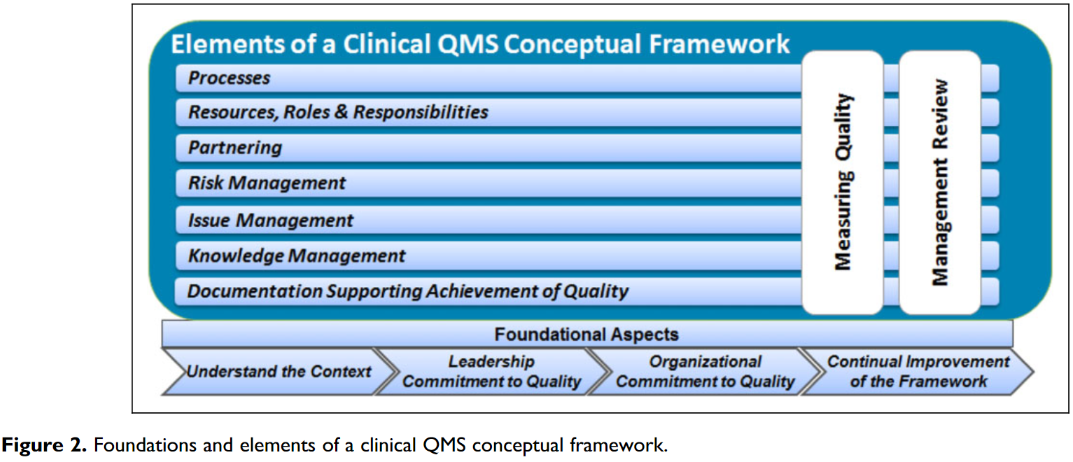
Components of the framework helps organization compartmentalize and deliver on the final vision and strategy. Key components within which we are foundational include:
- Understanding the context (Internal & External environments)
- Leadership Commitment to Quality (e.g., proactive risk mitigation)
- Organizational Commitment (e.g., ownership by everyone)
- Continuous Improvement (e.g., never satisfied with status quo)
https://journals.sagepub.com/doi/pdf/10.1177/2168479015596018
1 - Interlocking SIPOCs
Interlocking SIPOCs: Bringing Lean Strategies into the Digital Age
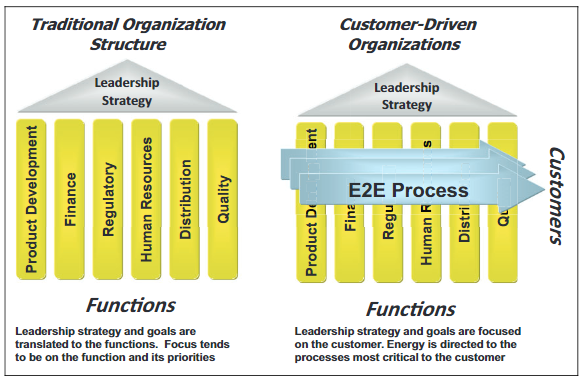
Process management is obviously important in any organization that is looking to achieve scalability and repeatability and thereby a strategy for building integrated processes at various levels of the organization is required. A method by which one can achieve these processes is through interlocking SIPOCs whereby the output of one process is the input of another process. In such a way, your creating a series of processes that can be linked into a graphical network thereby driving at transparency and clearly defined accountabilities. Within the community of knowledge management, this is done via linked data or semantic web.
Components of the framework
- Define and Characterize Processes (Processes at varying levels of the organization - See Interlocking SIPOCs)
- Determine Process Documentation strategy (Process map then documentation - digital workflows)
- Drive Flawless execution through a learning approach (drives at recording the actual process not just theoretical)
- Monitor and improve process performance (Digital signatures of volume, veracity, velocity need to be taken into account)
https://link.springer.com/content/pdf/10.1177/2168479018817751.pdf
2 - Knowledge Management
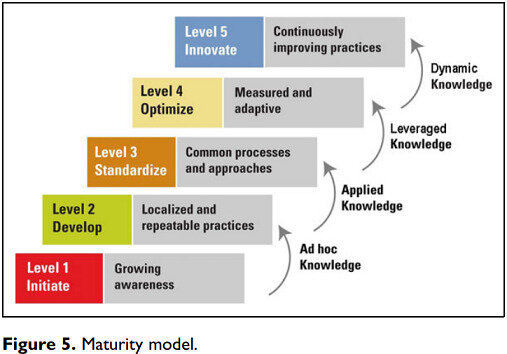
A Knowledge Management Framework and Approach for Clinical Development
Knowledge management is probably one of the most difficult problems to tackle in this modern digital age for the shear volume, veracity, variety and velocity at which new content is generated makes it difficult to reassemble if deliberate actions for organization and tagging where not taken before hand. Fortunately there’s hope, for we’re not in this alone, literally the entire world is struggling with this problems and scientists, technologists, engineers and mathematicians (STEM) have been deliberately attacking this problem through the creation of art (visualizations) - thereby transforming STEM to STEAM.
Driving a knowledge management framework in an organization enables exchange of information between people and systems seamlessly and deliberately which enables:
- Lowers errors due to lack of data transcription (i.e., copy/paste)
- More repeatable and predictable outcomes leading to increased flexibility and agility for the business
- Ultimately drives innovation and continuous improvement practices within the ecosystem of systems and humans (i.e., get the systems working for humans not the other way around)
https://link.springer.com/content/pdf/10.1177/2168479016664773.pdf
3 - Risk Framework
Quality Risk Management Framework: Guidance for Successful Implementation of Risk in Clinical Development
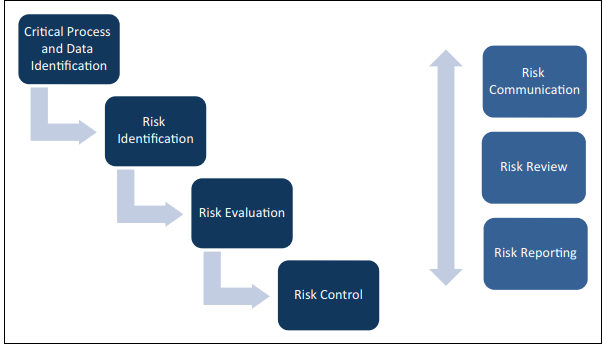
Risk management is a key term used across many organizations as an effective means to communicate broader sustained exposures to the organization and thereby drive a more end to end mindset focused upon the patients safety and efficacy. The critical component on establishing an effective risk management framework is following the entire 4 step process as outlined below.
The minimal requirements for an effective risk management methodology based on ICH E6(2):
- Critical Process and Data Identification (e.g., prior to identification of critical - you need to define the process itself - hence the homosapien bioreactor work)
- Risk Identification (arises from the tracking between process steps and quality attributes/KPI’s associated)
- Risk Evaluation (further refinement of risk identification for prioritization)
- Risk Control (defining the mechanisms you are going to take to control those risks)
https://link.springer.com/content/pdf/10.1177/2168479018817752.pdf