Artificial Intelligence
Categories:
2 minute read
There has been a lot of hype around AI and pharma - how it can reduce costs and remove a lot of manual labor that for sometime was always seen as necessary human activities, that is writing. But now with large language models, AI can really start eroding away at those manual human tasks and launch us into the Industry 5.0 mentality of workers with AI assistance to do their jobs.
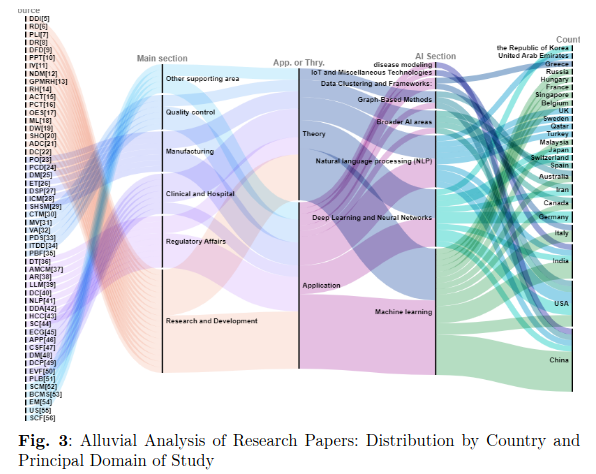
Where countries are spending their time - ref: https://arxiv.org/pdf/2401.10273
Recent Trends#
A great paper was published
Machine Learning Techniques: This category encompasses a variety of algorithms, including Support Vector Machines (SVM), Reinforcement Learning, and other traditional machine learning methods.
Deep Learning and Neural Networks: This includes models like Convolutional Neural Networks (CNN), Transfer Learning, Digital Twins (DTs), and other approaches based on neural network architectures.
Natural Language Processing (NLP): This segment covers all aspects of NLP, including Large Language Models (LLMs).
Graph-Based Approaches: Involves methods that leverage network and knowledge graphs, along with various graph-related techniques.
Data Clustering and Frameworks: Encompasses specialized frameworks such as Density-Based Spatial Clustering of Applications with Noise (DBSCAN), Federated Learning Frameworks, and other clustering or data framework technologies.
IoT and Miscellaneous Technologies: A broad category for various technologies, including the Internet of Things (IoT) and others that don’t neatly fit into the previously mentioned categories.
Feedback
Was this page helpful?
Glad to hear it! Please tell us how we can improve.
Sorry to hear that. Please tell us how we can improve.